

Board Performance · 2025
In this section15 topics
- Compliance Monitoring — Overview2 items
- Prevention of Conflicts of Interest3 items
- Prevention of the Use of Inside Information3 items
- Anti-Corruption4 items
- Whistleblowing4 items
- Selection of Directors & Chief Executives6 items
- Selection of Independent Directors2 items
- Director Development1 item
- Evaluation of Board & Subcommittee Performance4 items
- Subcommittees1 item
- Meeting Attendance & Remuneration4 items
- Supervision of Subsidiaries & Associated Companies4 items
- Board Duty Performance — Overview1 item
- Audit Committee Duty Performance1 item
- Executive Committee Duty Performance1 item
Compliance Monitoring — Overview
Compliance Monitoring — Introduction
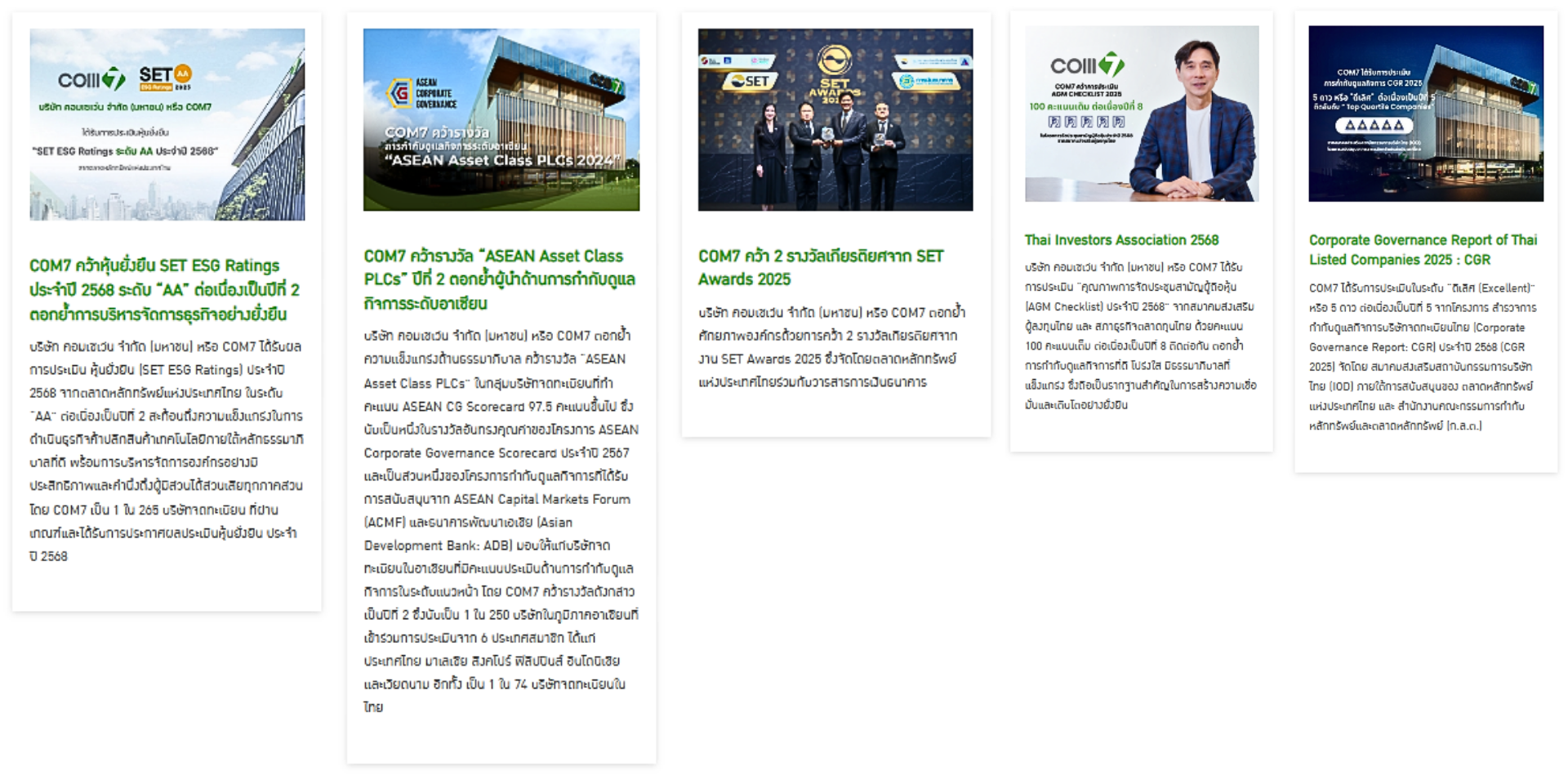
The company is committed to continuously developing and improving its “Good Corporate Governance” and “Business Ethics” for the company and its subsidiaries. An independent external agency conducts annual assessments to utilize the results for further improvements, and the assessment results are widely disseminated to shareholders and stakeholders. According to the Corporate Governance Report of Thai Listed Companies 2025, conducted by the Thai Institute of Directors Association in collaboration with the Stock Exchange of Thailand and the Securities and Exchange Commission, the company was rated at the level of “Excellent” for the fifth consecutive year, receiving an Excellent CG Scoring of 105 points, an increase from the previous year.
Additionally, in 2025, the company was categorized into the group of Top Quartile Companies in the category of companies with a market capitalization between 30,001–100,000 million Baht, reflecting the company's commitment to operating its business under the principles of good corporate governance sustainably.
Furthermore, the company monitors 4 additional issues to ensure compliance with good corporate governance practices. The results of policy implementation can be tracked as follows:
Monitoring of Compliance with Other CG Policies & Guidelines
Summary of the monitoring results of compliance with other corporate governance policies and guidelines over the past year.
Policy and Guideline Formulation: The Board of Directors has reviewed and approved the Good Corporate Governance Policy ( CG Policy) and the Business Code of Conduct ( Code of Conduct) in writing, to serve as a clear framework and guideline for all directors, executives, and employees within the organization.
Communication and Understanding: These policies and guidelines are communicated thoroughly to employees at all levels through various internal channels, such as email or the company's website, to ensure that everyone understands and can comply correctly.
Compliance with Laws and Regulations: The company has ensured that its operations strictly comply with relevant laws, regulations, and resolutions of shareholders' meetings, including the reporting of directors' and executives' interests.
Risk Management and Internal Control: An appropriate and sufficient risk management and internal control system has been established, overseen by the Risk Management Committee ( Risk Committee) and the Audit Committee is responsible for overseeing and reviewing the suitability of such systems at least once a year.
Information Disclosure and Transparency: The company prioritizes the accurate, complete, sufficient, and timely disclosure of important information, including both financial and non-financial data, through the Stock Exchange of Thailand's information system and the company's website.
Care for Stakeholders' Rights and Equality: The company recognizes the importance of and safeguards the rights of shareholders and all stakeholder groups equally and fairly, including the prevention of conflicts of interest.
Performance Evaluation and Review: The implementation of policies and guidelines is regularly monitored and evaluated, and policies are reviewed annually to align with changes in the business environment and international standards.
During the year, the Company continued to uphold its commitment to good corporate governance, supporting credibility, transparency, and sustainable growth. The Company publicly disclosed its Anti-Corruption Policy and related practices via the Company’s website under the Investor Relations section. The Company did not identify any significant breaches of ethical conduct by directors and executives involving serious violations of applicable laws or regulations.
Prevention of Conflicts of Interest
Has the Company Acted to Prevent Conflicts of Interest?
Yes
Operations in the Past Year
The Company has established a policy that the Board of Directors, executives, and employees must perform their duties for the utmost benefit of the Company. In cases where any individual has a conflict of interest or is involved in a matter under consideration, such individual must inform the Audit Committee and recuse themselves from the consideration of such transaction. In the past year 2025, the Company has reviewed cases that might lead to conflicts of interest and found no actions that contradict the Company's established policy for preventing conflicts of interest. Furthermore, the Company has developed e-learning materials and tests on conflict of interest prevention practices to enable directors, executives, and employees to review their understanding of the relevant guidelines for implementation. 100% of the Company's directors, executives, and employees have acknowledged the policy and practices regarding conflict of interest prevention through the aforementioned learning materials.
Number of Conflict-of-Interest Cases
| Metric | Current Year | Previous Year | Two Years Ago |
|---|---|---|---|
| Total number of cases or issues related to conflicts of interest (cases) | 0 | 0 | 0 |
Prevention of the Use of Inside Information
Has the Company Acted to Prevent the Use of Inside Information?
Yes
Operations in the Past Year
The Company has established a policy to prevent the use of inside information for personal gain, specifically to prevent the use of such information for trading the Company's securities. Directors and executives, as well as departments involved with critical information, are prohibited from trading the Company's securities 7 days prior to the release of financial statements and are permitted to trade 1 business day after the release. In the past year, no directors or executives traded the Company's securities. An inspection revealed full compliance. Furthermore, the Company has implemented an electronic system to enhance reporting efficiency for directors, executives, and employees.
In 2025, the Company will monitor operations to ensure compliance with the policy and guidelines on the use of inside information for personal gain, as stipulated in the corporate governance policy. Learning materials and tests on the policy and guidelines regarding the use of inside information have been developed in an e-learning format. This is to enable directors, executives, and employees to review their understanding of the practices to be observed and the penalties for violating these practices in various cases, such as insider trading, disclosing confidential company information to unauthorized persons, or using inside information for personal benefit. All directors, executives, and employees of the group companies (100%) participated in the review of the policy and guidelines on preventing the use of inside information for personal gain.
Number of Inside-Information Cases
| Metric | Current Year | Previous Year | Two Years Ago |
|---|---|---|---|
| Total number of cases or issues related to the use of inside information to seek benefits (cases) | 0 | 0 | 0 |
Anti-Corruption
Has the Company Acted on Anti-Corruption?
Yes
Operations in the Past Year
The company has implemented its Anti-Corruption Policy as follows:
-
The company has communicated and disseminated the Anti-Corruption Policy and guidelines for anti-corruption practices, including channels for reporting tips or complaints, as well as to inform directors, executives, and employees, stipulating that all processes must strictly adhere to legal frameworks, through various channels such as orientation for new directors and employees, and announcements on public notice boards. the campaign against receiving gifts ( No Gift Policy) through public display screens email, company website, etc., as well as providing training and conducting assessments to test understanding of the Anti-Corruption Policy, including guidelines for anti-corruption practices, along with Business Ethics and Code of Conduct, with the objective of promoting a shared understanding of the company's ethics, which will help build trust and acceptance, as well as foster sustainable growth for the company.
-
The company provides channels for reporting policy violations or acts of corruption, and has protective measures for whistleblowers.
-
The company has assessed risks related to corruption to identify, analyze, and manage potential corruption risks in each department. This process helps the organization understand weaknesses and identify which departments are susceptible to specific types of corruption, such as bribery, embezzlement, or conflicts of interest.
-
The company has established appropriate control measures to develop or improve policies, work procedures, and internal control systems to prevent or reduce the likelihood of corruption. Resources are allocated efficiently, prioritizing high-risk departments. Compliance with laws and international standards demonstrates the organization's commitment to anti-corruption and helps meet relevant legal requirements.
The company has disclosed details of its Anti-Corruption Policy, including guidelines for anti-corruption practices, and made them available to the general public through the company's website ( http://www.comseven.com ) under the Investor Relations section.
Form of Anti-Corruption Operations
| Operation |
|---|
| Review of appropriateness in anti-corruption |
| Assessment and identification of corruption risk |
| The monitoring of the evaluation of compliance with the anti- corruption policy |
| The participation in anti-corruption projects |
| Communication and training for employees on anti-corruption policy and guidelines |
| Review of the completeness and adequacy of the process by the Audit Committee or auditor |
Number of Corruption Cases
| Metric | Current Year | Previous Year | Two Years Ago |
|---|---|---|---|
| Total number of cases or issues related to corruption (cases) | 0 | 0 | 0 |
Whistleblowing
Has the Company Implemented Whistleblowing Procedures?
Yes
Operations in the Past Year
The company provides channels for receiving feedback and suggestions from employees, external parties, and stakeholders to reflect issues, report tips, or file complaints. In cases where incidents or actions may constitute human rights violations, tips or complaints can be reported to the company via two channels: Telephone: Call Center 02-017-7770 and Website: https://bit.ly/HRcom7Care to incorporate feedback for review, revision, and prevention of potential risks.
Number of Whistleblowing Cases
| Metric | Current Year | Previous Year | Two Years Ago |
|---|---|---|---|
| Total number of cases or issues received through whistleblowing channels (cases) | 6 | 6 | 0 |
Details of Whistleblowing Cases
| Status | Period Type | Start of Period | End of Period | Details of the Case or Issue | Investigation Results | Corrective Actions | Case or Issue |
|---|---|---|---|---|---|---|---|
| Incident no longer subject to action | Within (month/year) | 2025-05 | 2025-05 | Product delivery was delayed due to customers placing pre-orders. | Clarification and product delivery to the customer have been completed. | Expedite delivery from the nearest branch to the customer. | 3201 · Other name: Customer aspects concerning products and delivery · Description: Other |
| Incident no longer subject to action | Within (month/year) | 2025-02 | 2025-02 | Delayed shipment | Clarification has been provided and the goods have been delivered to the customer. | Expedite delivery from the nearest branch to the customer. | 3201 · Other name: Customer aspects concerning products and delivery · Description: Other |
| Incident no longer subject to action | Within (month/year) | 2025-08 | 2025-08 | Product is not functional | The product was found to be unusable, and a claim has been submitted. | Report issues to partners for further product development. | 3201 · Other name: Customer aspects concerning products and delivery · Description: Other |
| Incident no longer subject to action | Within (month/year) | 2025-11 | 2025-11 | Delayed delivery of goods | Clarification has been provided and the goods have been delivered to the customer. | Expedite delivery from the nearest branch to the customer. | 3201 · Other name: Customer aspects concerning products and delivery · Description: Other |
| Incident no longer subject to action | Within (month/year) | 2025-03 | 2025-03 | Service staff impolite | The employee spoke impolitely to customers. | Emphasize to employees to treat customers with willingness and courtesy. | 3201 · Other name: Operational Processes · Description: Other |
| Incident no longer subject to action | Within (month/year) | 2025-06 | 2025-06 | The employee presented incomplete product information. | Staff reported incomplete product information as the product data had not been updated. | Update product information and enhance update channels for employees to ensure immediate access to information. | 3201 · Other name: Operational Processes · Description: Other |
Selection of Directors & Chief Executives
Selection — Introduction
Criteria for Director Selection
The Company has established a Nomination and Remuneration Committee to consider and select directors. The criteria for nomination are based on the nature of the Company's business operations and strategies. Therefore, the qualifications of the directors to be nominated are set to be appropriate and consistent with the Company's business strategies, taking into account necessary missing skills and a Board Diversity policy, encompassing professional skills, specialized expertise, knowledge, abilities, and work experience for consideration, in order to identify suitable individuals with experience, knowledge, and abilities that will benefit the Company to serve as directors or executives. Furthermore, individuals appointed as directors or executives of the Company must possess full qualifications as stipulated in Section 68 of the Public Limited Company Act B.E. 2535 (including any amendments) and the announcements of the Securities and Exchange Commission (SEC), and must not have any prohibited characteristics under the Securities and Exchange Act (including any amendments), other relevant laws, and regulations.
According to the Company's Articles of Association, the Board of Directors shall consist of at least 5 but not more than 15 directors. Additionally, it must include at least one-third (1/3) of the total number of directors as independent directors, but not less than 3 persons. Furthermore, not less than one-half (1/2) of the total number of directors must reside in Thailand and possess qualifications as prescribed by law. Currently, the Company's Board of Directors comprises 7 members, a number appropriate for the Company's business operations. All directors possess extensive work experience and have served in top executive positions in both the business and public sectors. In terms of education, there are directors with degrees in business administration, accounting, and economics. All 7 directors possess knowledge, expertise, and abilities relevant to the business and consistent with the Company's business strategies, meeting the Company's desired qualifications. This ensures that the current composition of the Company's Board of Directors includes highly qualified individuals with diverse professional experience and expertise, comprehensively covering all relevant aspects.
Process for Nomination and Appointment of Directors
The selection of individuals to be appointed as company directors must go through the nomination process of the Nomination and Remuneration Committee and receive approval from the shareholders' meeting. There is no fixed number of directors based on the shareholding proportion of each shareholder or group. The Board of Directors provides equal opportunities for all shareholders and groups to nominate individuals whom they deem suitable to be directors. Nominations can be submitted through the channels specified on the company's website in advance, within the period stipulated before the Annual General Meeting, which is typically 3 months before the end of the accounting period. The qualifications for individuals deemed suitable to serve as directors, as determined by the Board, must include being highly qualified, possessing expertise from various professional fields, demonstrating leadership, having vision, upholding ethics and morality, having a good work history, and being able to express independent opinions. The voting for director elections will be conducted by individual ballot, with the criteria and election methods as per the Company's Articles of Association, as follows:
(a) One shareholder shall have one vote per one share.
(b) Each shareholder shall cast all available votes as per (a) for the candidate(s) they vote for. The election method may be for an individual or multiple individuals. Shareholders cannot divide their votes in the election of directors to give different numbers of votes to different candidates.
(c) The individuals who receive the highest votes in descending order shall be elected as directors to be appointed or elected on that occasion.
At every Annual General Meeting of Shareholders, one-third of the directors shall retire from office. If the number of directors cannot be divided into three equal parts, the number closest to one-third shall retire. Directors who must retire from office in the first and second years following the conversion shall be determined by drawing lots. In subsequent years, the director who has held office for the longest period shall retire. A retiring director may be re-elected by the shareholders' meeting. In addition to retirement by rotation, a director shall vacate office upon death, resignation, disqualification, or having prohibited characteristics under the law, or if the shareholders' meeting resolves to remove them with votes of not less than three-fourths of the shareholders present and entitled to vote, and holding shares totaling not less than one-half of the shares held by shareholders present and entitled to vote, or if a court orders their removal.
Directors & Chief Executives — Introduction
Recruitment of Directors and Appointment of Senior Executives
Director Selection Process
In the recruitment, selection, and nomination of suitable individuals for director positions that have completed their term, and/or have become vacant, and/or require additional appointments, the Nomination and Remuneration Committee will consider candidates based on their knowledge, abilities, expertise, and experience, a strong work history, broad vision, as well as ethics and morality. Candidates must be able to dedicate sufficient time to the company and diligently perform their duties and responsibilities, which will benefit the company's operations. Furthermore, the committee considers diversity in the board structure (Board Diversity) and prepares a comprehensive composition and qualification matrix (Skill Matrix) to define the qualifications of desired directors, taking into account essential missing skills, as well as suitable qualifications aligned with the composition and structure of directors according to the company's business strategy, without limitation based on gender, age, race, nationality, religion, or any other differences.
Senior Executive Selection Process
The Nomination and Remuneration Committee will be responsible for recruiting individuals for senior executive positions, screening candidates based on suitable qualifications, knowledge, abilities, skills, and experience beneficial to the company's operations. Candidates must possess a thorough understanding of the company's business and be capable of managing operations to achieve the company's objectives and goals. Following the selection process of suitable individuals, their names will be proposed to the Board of Directors for further consideration and approval.
In addition to the knowledge and abilities required to meet the criteria and align with the company's business, the company has defined the essential competencies for individuals aspiring to become the Chief Executive Officer, with the following qualifications:
1. Driving for Results Executives must prioritize goals in all aspects of the business, focusing on creating processes that are results-oriented and achieve maximum efficiency. They must be able to motivate and ensure that management and employees envision the company's objectives to achieve distinctive results, and maintain momentum to consistently reach new challenging goals.
2. Lead Strategic Direction Able to define and lead the business direction and strategic plans for both the short and long term, based on systematic data analysis, as well as various business-related factors, market drivers, organizational values, including economics, technology, and emerging regulations.
3. Driving Innovation Create an environment that fosters the development of measurable, creative solutions. Encourage experimentation with new approaches to problem-solving and seize opportunities to implement innovative methods.
4. 360 Degree Decision Making Able to make decisions by connecting data from multiple perspectives and various datasets to quickly understand and resolve issues, by exploring different alternatives to facilitate the most efficient and effective decision-making.
5. Entrepreneur Spirit Possess a sense of ownership, using it as a driving force to seek out and seize business opportunities, including creating new markets, launching new products and services, and/or striving to generate profits for the company.
6. Collaboration Establish and maintain strategic relationships with diverse stakeholder groups and potential partners, both internal and external to the organization, such as customers, colleagues, cross-functional partners, external vendors, and alliances, who can share information, ideas, and expertise to enhance understanding of business issues, thereby accelerating the achievement of shared business goals.
7. Digital Acumen Possess a deep understanding of new opportunities arising from technology, including the challenges and implications. Apply this understanding in a technology-driven environment, leading to greater access, value creation, and the discovery of new opportunities.
8. Building Talents Executives must understand and recognize the importance of developing high-potential employees. They must create and support systems and processes that attract, develop, motivate, and retain talented individuals within the organization, fostering a work environment where people can develop themselves to their fullest potential.
9. Customer Centricity Utilize internal and external customer perspectives as the driving force behind strategic prioritization, business decisions, and various organizational activities. Innovate and deliver services that maximally meet the needs of customers and the organization.
Are Directors Selected Through the Nomination Committee?
Yes
Are Chief Executives Selected Through the Nomination Committee?
Yes
Rights of Minority Shareholders on Director Appointment
The company clearly specifies the agenda items to be proposed at the ordinary and extraordinary general meetings of shareholders, without any other agenda items that do not yet have a topic for the meeting's consideration. Furthermore, on the day of the meeting, the company also avoids adding other agenda items not predetermined for the shareholders' meeting, as this would be unfair to shareholders who are not present at the meeting. For the agenda item concerning the election of directors, the company specifies the names and attaches a brief resume for each director proposed for shareholders' consideration. The company provides shareholders with the opportunity to cast individual votes for the election of directors. Similarly, for the agenda item concerning the appointment of auditors, the company clearly specifies the name of the auditor, the affiliated firm, experience, competence, independence, and the duration of their service as the company's auditor, including the auditor's remuneration. This is to enable shareholders to consider the suitability of the auditor. Furthermore, when proposing the approval of dividend payments (if any), the company will inform shareholders of the company's dividend payment policy, the proposed dividend rate, along with reasons and supporting information for consideration. The company also does not neglect to treat shareholders equally regarding share repurchases.
Method of Director Appointment
| Method |
|---|
| Method whereby each director requires approval votes more than half of the votes of attending shareholders with voting rights |
Selection of Independent Directors
Criteria for Selecting Independent Directors
Criteria for Selection of Independent Directors (Qualifications/Recruitment Process)
The company has defined its independent directors as non-executive directors who are not involved in day-to-day management and are not major shareholders in the company. The company has set qualifications equivalent to the minimum requirements of the SEC and the Stock Exchange. The Board of Directors has appointed an Audit Committee, composed entirely of independent directors, to assist in corporate governance oversight.
The criteria for selecting independent directors are based on the criteria for selecting company directors. The qualifications of individuals serving as independent directors are considered based on the qualifications and prohibited characteristics of directors under the Public Limited Company Act and the Securities and Exchange Act, including related notifications, regulations, and/or rules. Independent directors must possess qualifications, education, specialized expertise, work experience, and other suitable attributes, which will then be proposed to the shareholders' meeting for consideration and appointment as directors of the company.
The company has stipulated that the composition of the Board of Directors must include at least one-third of the total number of directors as independent directors, and individuals nominated as independent directors of the company must fully meet the defined qualifications.
Qualifications of Independent Directors
holding no more than one percent of the total voting shares of the Company, parent company, subsidiary, associate company, major shareholder or controlling person of the Company, including shares held bythe connected persons of such independent director.
not being or having been an executive director, employee, staff, advisor earning regular monthly salary or the controlling person of the Company, its parent company, subsidiary, associate company, same-level subsidiary, major shareholder or controlling person, unless the foregoing status has ended for at least two years prior to the date of appointment as a director of the Company. In this regard, such prohibited characteristics shall exclude the case where an independent director used to be a government official or advisor of a governmental agency, which is a major shareholder or the controlling person of the Company.
not being a person who is related by blood or legal registration as father, mother, spouse, sibling and child, including spouse of child, other directors, executives, major shareholders, controlling person or person to be nominated as director, executive or controlling person of the Company or its subsidiary.
not having or having had a business relationship with the Company, its parent company, subsidiary, associate company, major shareholder or controlling person in a manner that may interfere with independent discretion, which includes not being or having been a significant shareholder or the controlling person of any person having a business relationship with the Company, its parent company, subsidiary, associate company, major shareholder or controlling person, unless such foregoing relationships have ended for at least two years prior tothe date of appointment as a director of the Company.
The business relationship under Paragraph 1 shall include normal business transactions, rental or lease of real estate, transactions related to assets or services or granting or receipt of financial assistance through receiving or extending loan, guarantee, providing assets as collateral, and any other similar actions, which result in the Company or the counterparty being subject to indebtedness payable to the other party in an amount staring from three percent of the net tangible assets of the Company or from twenty million baht or more, whichever amount is lower. In this regard, the calculation of such indebtedness shall be in accordance with the method for calculating the value of related party transactions under the Notification of the Capital Market Supervisory Board Re: Rules on Execution of Related Party Transactions, mutatis mutandis. In any case, the consideration of such indebtedness shall include the indebtedness incurred during the period of one year to the date of establishing the business relationship with the related person.
not being or having been an auditor of the Company, its parent company, subsidiary, associate company, majority shareholder, or controlling person, and not being a significant shareholder, controlling person, or partner of the audit firm which employs the auditor of the Company, its parent company, subsidiary, associate company, majority shareholder, or controlling person, unless the foregoing relationship has ended for not less than two years prior to the date of appointment as a director of the Company.
not being or having been a provider of professional services, which includes serving as a legal advisor or financial advisor being paid with a service fee of more than two million baht per year by the Company, its parent company, subsidiary, associated company, majority shareholder, or controlling person, and not being a significant shareholder, controlling person, or partner of such provider of professional services, unless the foregoing relationship has ended for not less than two years prior to the date of appointment as a director of the Company;
not being a director who is appointed as the representative of directors of the Company, major shareholder, or shareholder who is a connected person of a majority shareholder.
not undertaking any business of the same nature and in significant competition with the business ofthe Company or its subsidiary, or not being a significant partner in a partnership, or an executive director, employee, staff, advisor earning regular monthly salary, or holding more than one percent of the voting shares of another company that undertakes a business of the same nature and in significant competition with the business of the Company or its subsidiary;
not having any other characteristics that cause the inability to express independent opinions on the business operation of the Company.
In the past year 2025, the current Independent Directors and Audit Committee comprised 3 directors, meeting the SEC's criteria. All three independent directors have no business relationships or professional service engagements exceeding the specified thresholds, and there is no impact on their performance of duties or ability to provide independent opinions, which are the reasons and necessity for their continued appointment or re-appointment as independent directors.
Did Any Independent Director Have a Business or Professional Relationship?
No
Director Development
Qualifications for Director Selection
| Qualification | Skill & Expertise |
|---|---|
| 1) Possess qualifications and not have prohibited characteristics under the Public Limited Company Act B.E. 2535 (1992) or other relevant laws, as well as the regulations of the Stock Exchange of Thailand (SET) and the Securities and Exchange Commission (SEC), and the company's articles of association. 2) Be a qualified person, possess knowledge and capability, and have experience beneficial to the company's business operations. 3) Possess leadership and vision, and have independence in decision-making for the utmost benefit of the company and its shareholders as a whole. 4) Be responsible for performing director duties and be able to fully dedicate time to performing the company's director duties, as well as consistently demonstrate accountability to shareholders and make decisions with due care to protect the company's interests. 5) Perform duties with honesty, integrity, and ethics within the framework of the law, as well as good corporate governance guidelines and business ethics. The Board of Directors recognizes its roles and responsibilities in guiding operational direction, monitoring and overseeing the management's work, performing duties with knowledge, capability, transparency, and prudence, and demonstrating accountability of the Board of Directors to the company and its shareholders, while being independent from the management. | 140 · Description: Information & Communication Technology · 141 · Description: Law · 143 · Description: Accounting · 144 · Description: Finance · 147 · Description: Sustainability |
Evaluation of Board & Subcommittee Performance
Evaluation — Introduction
The company has prepared a self-assessment form for directors to ensure that such assessment adheres to appropriate criteria consistent with good practices and the new Corporate Governance Code (CG Code) issued by the SEC. This also includes analyzing and evaluating the results obtained from the board of directors' performance assessment form, and compiling them into comments and recommendations for the company to utilize in improving and enhancing the efficiency of the board of directors' duties.
Criteria for Evaluating Board Performance
1. Director's Self-Performance Evaluation
The Board of Directors and the Executive Directors conduct annual self-assessments (Board Self-Assessment) both collectively and individually. This serves as a framework for reviewing the performance of the Board of Directors' duties, as well as considering, reviewing, and compiling feedback on various issues related to the company's operations and the Board of Directors' duties during the past year, in order to address them and enhance operational efficiency.
The criteria for self-performance evaluation are divided into 5 levels, as follows:
4 = Strongly agree or excellent action taken on the matter
3 = Fairly agree or good action taken on the matter
2 = Agree or reasonable action taken on the matter
1 = Disagree or minimal action taken on the matter
0 = Strongly disagree or no action taken on the matter
And the criteria for performance evaluation levels, calculated as a percentage of the full score for each item, are divided into 5 levels, namely:
More than 95% = Excellent
90% - 95% = Very Good
80% - 89% = Good
70% - 79% = Fair
Below 70% = Needs improvement
2. Performance Evaluation of Sub-Committees
In 2025, the Board of Directors mandates an annual self-assessment for all sub-committees, namely the Audit Committee, the Nomination and Remuneration Committee, the Risk Management Committee, and the Governance and Sustainability Committee. The results shall be reported to the Board of Directors annually to review the performance of the sub-committees and to consider, review, and compile feedback on various issues related to the sub-committees' duties during the past year, in order to address them and enhance operational efficiency.
The self-performance evaluation form for the committee is prepared according to the scope of authority, duties, and responsibilities as stipulated in the charter of each sub-committee, with evaluation topics concerning:
1) The structure and qualifications of the committee are appropriate, leading to efficient committee operations.
2) Sub-committee meetings have been conducted to enable the committees to perform their duties effectively during meetings.
3) The roles, duties, and responsibilities of the sub-committees have been given sufficient importance, time for consideration, review, and compliance.
The criteria for the self-performance evaluation of the sub-committees are divided into 5 levels, as follows:
4 = Strongly agree or excellent action taken on the matter
3 = Fairly agree or good action taken on the matter
2 = Agree or reasonable action taken on the matter
1 = Disagree or minimal action taken on the matter
0 = Strongly disagree or no action taken on the matter
And the criteria for performance evaluation levels, calculated as a percentage of the full score for each item, are divided into 5 levels, namely:
More than 95% = Excellent
90% - 95% = Very Good
80% - 89% = Good
70% - 79% = Fair
Below 70% = Needs improvement
3. Performance Evaluation of the Chief Executive Officer (CEO)
The Board of Directors has assigned the Nomination and Remuneration Committee to annually evaluate the performance of the highest-ranking executive in the organizational structure (Chief Executive Officer). This is to serve as a guideline for determining the Chief Executive Officer's remuneration and to present the evaluation results to the Board of Directors' meeting for acknowledgment and approval.
with evaluation topics
(1) Leadership
(2) Strategy Formulation
(3) Strategy Implementation
(4) Financial Planning and Performance
(5) Relationship with the Board
(6) External Relationships
(7) Management and Personnel Relationships
(8) Succession Planning
(9) Product and Service Knowledge
(10) Personal Attributes
(11) Comprehensive Performance on Sustainability
The criteria for the CEO's performance evaluation are divided into 5 levels, as follows:
N/A = No information or not applicable
4 = Excellent action taken on the matter
3 = Good action taken on the matter
2 = Agree or reasonable action taken on the matter
1 = Minimal action taken on the matter
0 = No action taken on the matter
And the criteria for performance evaluation levels, calculated as a percentage of the full score for each item, are divided into 5 levels, namely:
More than 95% = Excellent
90% - 95% = Very Good
80% - 89% = Good
70% - 79% = Fair
Below 70% = Needs improvement
Evaluation of Board Performance in the Past Year
1. Self-assessment results of directors
The self-assessment results of directors for 2025 can be summarized as follows:
Evaluation of the Entire Board
Evaluation Topics
1. Structure and Qualifications of the Board
2. Roles, Duties, and Responsibilities of the Board
3. Board Meetings
4. Performance of directors' duties
5. Relationship with Management
6. Self-development of directors and executive development
Scores : Excellent
Individual Director Evaluation
Evaluation Topics
1. Structure and Qualifications of the Board
2. Board Meetings
3. Roles, Duties, and Responsibilities of the Board
Scores : Excellent
In 2025, the Board of Directors and the Executive Committee's overall performance was rated "Excellent," with an average score of 99%. The committees performed their duties with knowledge and competence, in accordance with the scope of authority and responsibilities assigned by the charter, and in line with the best practices of regulatory bodies. The Company Secretary summarized the evaluation results of the Board of Directors and the Executive Committee and presented them to the Board of Directors at the Board of Directors Meeting No. 1/2026 on February 24, 2026.
2. Performance Evaluation Results of Sub-Committees
The self-assessment results of the sub-committee directors for 2025 can be summarized as follows:
| Average score 99% |
| Average score 98% |
| Average score 98% |
| Average score 98% |
In 2025, the sub-committees' overall performance was rated "Excellent," with an average score of 98.25%. The committees performed their duties with knowledge and competence, in accordance with the scope of authority and responsibilities assigned by the charter, and in line with the best practices of regulatory bodies. The Company Secretary summarized the evaluation results of all sub-committees and presented them to the Board of Directors at the Board of Directors Meeting No. 1/2026 on February 24, 2026.
3. Performance Evaluation Results of the Chief Executive Officer (CEO)
In 2025, the Chief Executive Officer (CEO)'s overall performance was rated "Excellent," with an average score of 99%. The CEO performed duties with knowledge and competence, in accordance with the scope of authority and responsibilities assigned by the charter, and in line with the best practices of regulatory bodies. The Company Secretary summarized the evaluation results and presented them to the Board of Directors at the Board of Directors Meeting No. 1/2026 on February 24, 2026.
Evaluation Results
| Evaluated Body | Group — Carried Out? | Group — Grade / Average Score | Group — Grade / Full Score | Individual (Self-Assessment) — Carried Out? | Individual (Self-Assessment) — Grade / Average Score | Individual (Self-Assessment) — Grade / Full Score | Cross (Assessing Other Directors) — Carried Out? |
|---|---|---|---|---|---|---|---|
| Board Of Director | Y | 99 | 100 | Y | 99 | 100 | N |
| Audit Committee | Y | 99 | 100 | Y | 99 | 100 | N |
| Other Subcommittee | Y | 98 | 100 | Y | 98 | 100 | N |
| Executive Committee | Y | 99 | 100 | Y | 99 | 100 | N |
| Other Subcommittee | Y | 98 | 100 | Y | 98 | 100 | N |
| Other Subcommittee | Y | 98 | 100 | Y | 98 | 100 | N |
Subcommittees
Subcommittees
| Results of the Subcommittee's Duty Performance |
|---|
The Nomination and Remuneration Committee has performed its assigned duties with care, prudence, transparency, fairness, and provided straightforward opinions in accordance with good corporate governance principles, primarily for the utmost benefit of shareholders, investors, and all stakeholders. |
The Risk Management Committee has fully performed its duties in overseeing the Company’s key enterprise risks in accordance with its charter. The Committee has continuously developed and enhanced the Company’s enterprise risk management framework to ensure alignment with the evolving business environment and future uncertainties. In addition, the Risk Management Committee has closely monitored risk management practices and provided comprehensive recommendations on significant risk issues, including emerging risks that may affect the Company’s business in the future. The Committee has carried out its responsibilities effectively and appropriately, ensuring that risks are managed within acceptable levels. This enables the Company to achieve its objectives and maximize value for shareholders, investors, and all stakeholders. |
The Corporate Governance and Sustainability Committee has operated in accordance with good corporate governance principles and is committed to continuously developing and overseeing corporate affairs with prudence, thoroughness, transparency, fairness, and providing straightforward opinions, in line with good corporate governance principles, alongside conducting business in a balanced manner according to sustainable development in economic, social, and environmental dimensions, for the utmost benefit of shareholders, investors, and all stakeholders, as well as fully complying with relevant regulations. |
Meeting Attendance & Remuneration
Meeting Attendance — Remark
Remuneration — Introduction
The Company has established the remuneration for directors for the year 2025, comprising remuneration for the Board of Directors and the Audit Committee. The remuneration for the Company's directors for the year 2025 is set within the same total budget as the rate paid in 2024, payable in the form of monthly remuneration, meeting allowances, and directors' gratuities, with the following details:
Types of Remuneration of the Board of Directors
Payment of remuneration to individual directors
1. Monetary Remuneration
The Annual General Meeting of Shareholders for 2025, held on April 28, 2025, resolved to set the remuneration for the company's directors as follows:
(1) Monthly Remuneration
20,000 Baht/month | |
Chairman of the Audit Committee | 20,000 Baht/month |
Director | 10,000 Baht/month |
Audit Committee Member | 15,000 Baht/month |
(2) Meeting Allowance
40,000 Baht/month | |
Chairman of the Audit Committee | 40,000 Baht/month |
Director | 20,000 Baht/month |
Audit Committee Member | 25,000 Baht/month |
(3) Meeting allowance for chairpersons of sub-committees
Chairman of the Risk Management Committee | 20,000 Baht/month |
Chairman of the Corporate Governance and Sustainability Committee | 20,000 Baht/month |
Chairman of the Nomination and Remuneration Committee | 20,000 Baht/month |
(4) Directors' Gratuity An amount of 3,000,000 Baht, payable only to independent directors.
In determining the directors' remuneration this time, the Board of Directors considered and set the remuneration for the company's sub-committees. These sub-committees will receive remuneration according to the details specified above.
2. Non-monetary remuneration/Other remuneration
-None-
Remuneration or Benefits Payable to the Board
| Metric | Amount (Baht) |
|---|---|
| Remunerations or benefits pending payment to the board of directors over the past year (baht) | 60,000 |
Supervision of Subsidiaries & Associated Companies
Does the Company Have Subsidiaries or Associated Companies?
Yes
Is There a Mechanism for Overseeing Subsidiaries and Associated Companies?
Yes
Mechanism for Overseeing Management of Subsidiaries
In accordance with good corporate governance principles regarding the establishment of a framework and mechanism for supervising policies and operations in subsidiaries and other entities in which the company invests, the company has developed and reviewed its policy for supervising and managing core business subsidiaries and associates. The company will oversee the management of its subsidiaries by appointing company representatives as directors in the subsidiaries, at least in proportion to its shareholding. The nominated directors and executives must possess the qualifications, roles, duties, and responsibilities, and must not exhibit characteristics indicating a lack of trustworthiness as stipulated by the Securities and Exchange Commission's announcement on defining characteristics indicating a lack of trustworthiness of directors and executives of a company. The qualifications of the appointed individuals include:
Do not possess prohibited characteristics as stipulated by relevant laws or regulations.
Possess knowledge, abilities, and experience beneficial to business operations, and demonstrate leadership.
Make reasonable decisions in accordance with corporate governance guidelines and the company's code of conduct.
Directors and executives appointed by resolution of the company's Board of Directors to hold positions in subsidiaries and associates
have the following scope of duties and responsibilities:
Oversee that subsidiaries and associates comply with relevant laws, regulations, rules, and procedures, maintain good management practices, adhere to corporate governance principles, codes of conduct, the company's anti-corruption policy, and other policies consistent with the company.
Provide guidance in setting the direction of strategies, policies, and business plans for subsidiaries to align with the company's direction, and promote the use of technology to enhance the competitiveness of subsidiaries.
Report operational results and disclose financial status information of subsidiaries to the company accurately, completely, and in a timely manner.
Oversee the efficient operation of subsidiaries' businesses and appropriately manage the company's return on investment in subsidiaries.
To oversee and be responsible for ensuring that appropriate and robust internal control systems, risk management systems, and anti-corruption systems are in place, sufficient to ensure that the operations of the subsidiaries comply with the company's policies. Furthermore, directors and executives shall establish mechanisms for auditing such systems within the company by the internal audit team, and company directors shall have direct access to information. Audit results shall be reported to the company's directors and executives.
If a subsidiary conducts business operations that significantly impact the company, the subsidiary must obtain prior approval from the company's Board of Directors meeting, such as investing in any securities not within the approved securities or investment framework. Furthermore, key policies implemented by subsidiaries within the group must receive approval from the company's Board of Directors. In cases of transactions between a subsidiary or associate and related parties, such as the acquisition or disposal of significant assets, or in cases requiring a resolution or voting on important matters at a level equivalent to requiring approval from the company's Board of Directors, the company's representative must first submit a request for approval to the company's Board of Directors. Information disclosure and data storage, including accounting entries according to consolidated financial statement preparation criteria, must be completed within the specified timeframe.
Oversight Mechanisms
| Mechanism |
|---|
| Sending representatives to act as directors, executives or controlling persons in proportion to shareholdings |
| Defining the scope of powers, duties and responsibilities of directors and executives who represent the company in setting important policies |
| Transactions between the Company and related persons |
| Internal control system of the subsidiary operating the core business is appropriate and sufficient in the subsidiary operating the core business |
Board Duty Performance — Overview
Board Duty Performance — Overall Description
The Board of Directors plays a key role as representatives of shareholders in overseeing the Company’s operations to ensure efficiency, transparency, and alignment with good corporate governance principles. The Board is responsible for determining the Company’s objectives, policies, and key business goals, as well as establishing and reviewing the Company’s vision, mission, strategic plans, and annual budget, which are implemented by management.
The Board works closely with management in formulating and reviewing corporate strategies, targets, and annual plans, while ensuring the adequacy of risk management and internal control systems. In addition, the Board monitors and evaluates the Company’s performance and oversees accurate, complete, and timely disclosure of financial and non-financial information.
In 2025, the Board reviewed and approved the Company’s vision, mission, and strategies to ensure alignment with the business environment and operational direction. The Board also monitored the implementation of the Company’s strategies through regular management reports at Board meetings, including performance reviews against established targets and strategic plans, and provided strategic guidance to support the achievement of the Company’s objectives.
Audit Committee Duty Performance
Results of the Audit Committee's Duty Performance in the Past Year
The Audit Committee conducted annual performance evaluations, both individually and as a committee, and held meetings with management, internal auditors, and external auditors. The Audit Committee regularly reported its performance results and various recommendations to the Board of Directors every quarter. The key aspects of its duties can be summarized as follows:
Accuracy, Completeness, and Reliability of Financial Reports: Reviewed quarterly financial statements and the annual financial statements for 2025 with management and the external auditor to approve the financial reports, which were prepared correctly in all material respects, in accordance with generally accepted accounting principles. Also reviewed the full, adequate, and reliable disclosure of significant information, related party transactions, and transactions that may give rise to conflicts of interest. Additionally, held specific discussions with the external auditor without management present to understand issues identified during the audit, and to consider and provide opinions on the auditor's findings before submitting them to the Board of Directors for consideration.
Internal Control and Internal Audit Systems: Supervised internal audit work to ensure compliance with professional standards, utilizing risk assessment methods and internal control systems based on the COSO – Internal Control Integrated Framework. Also considered and approved the annual audit plan, which was prepared by considering various business risk factors, including staffing plans, personnel development plans, and operational budgets. In reviewing audit reports, the Audit Committee provided recommendations to both the internal audit department and management for the benefit of continuous operational development and improvement.
Compliance with Relevant Regulations and Laws: Reviewed the company's consistent compliance with the Securities and Exchange Act, regulations of the Stock Exchange of Thailand, and laws related to the company's business. The Committee is of the opinion that the company's compliance with the Securities and Exchange Act and related business laws, as reviewed, is adequate. Management was urged to monitor the key aspects of the promulgation of the Securities and Exchange Act and related announcements, as well as to report for close consideration and awareness.
Compliance with Anti-Corruption Measures: Reviewed policies and operational guidelines for implementing anti-corruption policies, as well as arranged for the assessment of risks related to internal and external corruption within the company. The company also received certification as a member of the Thai Private Sector Collective Action Against Corruption (CAC) in 2024. The Audit Committee is confident that the company has sufficient measures in place to effectively combat and detect fraud and corruption.
Disclosure of Related Party Transactions: Reviewed the disclosure of related party transactions and transactions that may potentially involve conflicts of interest, adhering to the principles of reasonableness in normal business operations, transparency, and adequate disclosure, similar to transactions with general third parties. This information has been duly verified and disclosed to the Stock Exchange of Thailand in a timely manner.
Selection and Proposal for Appointment of Auditor: Considered the performance and remuneration of the auditor based on business knowledge, experience, appropriateness of remuneration, and independence of the auditor. It was proposed to appoint Mr. Boonruang Lertvisesvit, Certified Public Accountant No. 6552, or Mr. Pongtawee Rattanakoset, Certified Public Accountant No. 7795, or Mr. Chaisiri Ruangritchai, Certified Public Accountant No. 4526, or Mr. Wichian Kingmontree, Certified Public Accountant No. 3977, from PricewaterhouseCoopers ABAS Ltd. as the company's auditor. This proposal has been submitted to the Board of Directors and approved by the Annual General Meeting of Shareholders for 2025.
Good Corporate Governance: Promoted and continuously monitored the progress of developing good corporate governance and social responsibility. Provided opinions on improving good corporate governance policies, organizational sustainability development policies, business ethics, and codes of conduct, as well as offering necessary guidance and recommendations for development. The company was rated 5 stars (Excellent) in the 2025 Thai Listed Companies Corporate Governance Report by the Stock Exchange of Thailand and the Thai Institute of Directors Association. It also received a renewal of its membership certification for the Thai Private Sector Collective Action Against Corruption (CAC). Furthermore, the company was selected for the "Sustainable Stocks" or SET ESG Rating list by the Stock Exchange of Thailand for 2025. The company is committed to developing good corporate governance processes, considering all stakeholders comprehensively, to ensure economic growth alongside balanced social and environmental development.
Risk Management: Supervised systematic risk management by regularly reviewing risk management reports and providing recommendations for improvement, as well as insights into risk perspectives.
In summary, the Audit Committee is of the opinion that the company's financial statements have been prepared in accordance with financial reporting standards, related party transactions adhere to the principles of reasonableness in normal business operations, transparency, and adequate disclosure. Risk management and internal control systems are sufficient and effective, and all relevant regulations have been fully complied with.
Executive Committee Duty Performance
Results of the Executive Committee's Duty Performance in the Past Year
The Executive Committee plays a significant role in driving the Company’s management in alignment with the policies of the Board of Directors, corporate strategies, objectives, and principles of Good Corporate Governance under a clearly defined governance framework. Throughout 2025, the Executive Committee performed its duties effectively in accordance with the established guidelines, with emphasis on corporate oversight, risk management, formulation of key policies, and close monitoring of management’s performance, as summarized below:
1. Strategic Governance and Business Decision-Making
The Executive Board has considered and proposed resolutions on several important agendas related to the company's business operations, taking into account sustainable growth and value for shareholders, as well as approving key investment plans, budget allocation, and supporting strategic projects aligned with business objectives.
2. Risk Management and Internal Governance
The Executive Board, in collaboration with relevant departments, has overseen the organization's risk management system to ensure its suitability and responsiveness to changing circumstances. This includes proactively considering approaches to significant risk management, monitoring the implementation of various measures, and supporting internal audits and legal compliance.
3. Supporting and Monitoring Adherence to Good Corporate Governance Principles
The Executive Board is responsible for monitoring the implementation of the company's good corporate governance policies, including reviewing related policies and practices such as preventing the use of inside information for personal gain, overseeing human rights, and treating stakeholders. Internal evaluations are conducted in collaboration with independent bodies to enhance transparency and social responsibility.
4. Promoting Stakeholder Engagement
The Executive Board systematically supports the engagement of all stakeholder groups through communication channels, accurate and complete information disclosure, and the organization of activities that create opportunities to listen to the opinions of shareholders, employees, customers, business partners, and the community, in line with ESG principles.
5. External Evaluation Results and Recognition
The results of the company's good corporate governance operations in 2025 are reflected in the evaluation from the Corporate Governance Report of Thai Listed Companies 2025 project, where the company received an "Excellent" rating for the fifth consecutive year with an increased Excellent CG Scoring. Furthermore, it was ranked among the Top Quartile Companies in the market capitalization category of 30,001–100,000 million baht, indicating external evaluators' confidence in the company's governance.
The aforementioned operational results demonstrate the Executive Board's role and responsibilities in effective, transparent corporate governance, consistent with good corporate governance principles. This is a crucial factor supporting stable growth and meeting the expectations of shareholders and all stakeholder groups.