

CG Policy · 2025
In this section7 topics
Corporate Governance Policy
Has a Corporate Governance Policy
Yes
Policy Description
Com7 Public Company Limited and its subsidiaries (hereinafter referred to as "the Company") are committed to developing the organization for sustainable growth, conducting business in compliance with laws, adhering to moral and business ethics principles (Code of Conduct), disclosing information transparently, developing internal control systems, and having effective and appropriate audit mechanisms. The Company operates with consideration for responsibility towards shareholders and all stakeholders. It has a board structure, governance mechanisms, and management that demonstrate capability and accountability in various matters, which are in line with the good standard frameworks of the OECD (Organization for Economic Cooperation and Development) and the ASEAN CG Scorecard.
The Board of Directors has established a "Corporate Governance Policy" (the full policy and guidelines can be found at http://www.comseven.com under the Investor Relations section). The Board of Directors initiated, participated in the development of, and approved this policy to promote the organization's good governance principles and to serve as best practices for directors, executives, employees of the company, its subsidiaries, and all stakeholder groups, which will genuinely lead to a sustainable organization. It covers key principles in accordance with good corporate governance principles. In 2025, the Board reviewed and approved the company's vision, mission, strategies, goals, and business direction, and also reviewed important policies to ensure their suitability and alignment with business operations under good corporate governance principles, such as the Corporate Governance Policy, Organizational Sustainability Development Policy, Business Ethics, and Code of Conduct for employees, among others.
The company has disclosed its corporate governance policy and practices, including its business ethics, which reflect the establishment of a framework and guidelines for corporate governance practices across all departments of the company. This can be summarized as follows:
Policy Document Link
https://www.comseven.com/ir_index.php?corporate
Policy & Practices — Board of Directors
Introduction
Board of Directors.
The Board of Directors is responsible to the shareholders for the company's business operations, overseeing the business to align with goals, laws, objectives, company regulations, resolutions of shareholders' meetings, and approaches that generate maximum benefit for shareholders, while considering the interests of all stakeholders. They perform their duties with honesty, integrity, and prudence to protect the interests of shareholders and stakeholders, both in the short and long term. For this reason, the Board of Directors will be elected by shareholders through a transparent process. All members must possess knowledge, expertise, and experience that can benefit the company, be dedicated, fully commit their time to their duties, demonstrate leadership, vision, and independence in decision-making. They must be able to ensure that work systems provide confidence that the company's various activities are conducted legally and ethically, and must be independent from the company's management, by establishing a clear separation of duties and responsibilities between the Board of Directors and management, considering the interests of all stakeholders, adhering to the principles of “Good Practices for Directors of Listed Companies” As stipulated by the Stock Exchange of Thailand, the Board of Directors consists of 7 members, comprising qualified individuals in business, accounting, and finance, all of whom are relevant to and support the company's entire business. Their term of office is 3 years, divided into 4 executive directors and 3 independent directors. The independent directors meet the qualifications and number requirements set by the Securities and Exchange Commission, meaning a listed company must have independent directors numbering more than or equal to one-third of the total number of directors. The company stipulates that the Board of Directors must possess the following qualifications:
Qualifications of the Board of Directors.
Possess qualifications and not have prohibited characteristics under the Public Limited Company Act B.E. 2535 (1992) or other relevant laws, as well as the regulations of the SET and SEC, and the company's articles of association.
Be a qualified person with knowledge, ability, and experience beneficial to the company's business operations.
Possess leadership, vision, and independence in decision-making for the utmost benefit of the company and its shareholders as a whole.
Be responsible for performing directorial duties and be able to fully dedicate time to the company's directorial duties, as well as consistently demonstrate accountability to shareholders and make decisions with due care to protect the company's interests.
Perform duties with honesty, integrity, and ethics, within the framework of the law, as well as good corporate governance guidelines and business ethics.
The Board of Directors recognizes its role, duties, and responsibilities in guiding operational direction, monitoring management's performance, and performing duties with knowledge, capability, transparency, prudence, and accountability to the company and its shareholders, while being independent from management. The key operational guidelines are as follows:
Role of the Chairman of the Board.
Do not participate in the company's normal day-to-day management.
Utilize leadership to ensure that the performance of duties by the entire Board of Directors is efficient for the utmost benefit of the company and independent from management.
Possess leadership, responsible for setting the company's strategies, direction, policies, goals, and missions, to ensure that management and employees have a unified purpose in their operations.
Monitor and ensure the implementation of the company's strategies, and that such implementation complies with relevant policies, regulations, laws, and various stipulations.
Consider and approve the meeting agenda proposed by the Company Secretary, which has already been approved by the Chief Executive Officer, to ensure the agenda aligns with the duties and responsibilities of the directors, and to allow each director the independence to propose matters beneficial to the company for inclusion in the agenda.
Allocate sufficient time for management to propose matters, and ample time for directors to carefully consider and discuss important issues thoroughly. Encourage directors to exercise prudent judgment and provide independent opinions.
The Chairman of the Board shall not be the chairman or a member of any sub-committee, to ensure the true independence of the sub-committees in performing their duties.
Oversee and encourage directors to adhere to good corporate governance principles and the company's business ethics, including compliance with the directors' code of conduct.
Foster good relationships between executive and non-executive directors, and between the Board of Directors and management.
Role of the Chief Executive Officer.
Utilize leadership to ensure that the executive directors perform their duties efficiently for the utmost benefit of the company and are independent from management.
Consider and approve the meeting agenda proposed by the Company Secretary, to ensure the agenda aligns with the duties and responsibilities of the executive directors.
Oversee executive directors to ensure they implement policies received from the Board of Directors effectively.
Oversee and encourage executive directors to adhere to good corporate governance principles and the company's business ethics.
Term of office for directors.
At every Annual General Meeting of Shareholders, one-third of the directors shall retire from office. If the number of directors cannot be divided exactly into three parts, the number closest to one-third shall retire. Directors who must retire in the first and second years after conversion shall be determined by drawing lots. In subsequent years, the director who has been in office for the longest period shall retire.
Directors who have retired from their positions may be re-elected by the shareholders' meeting.
Methods for Election/Appointment of the Board of Directors. Can occur in 2 cases, namely:
The election of directors to replace those retiring by rotation must be approved by the shareholders' meeting.
Appointment of directors during the term due to a vacancy. The Board of Directors can consider and approve based on the selection and nomination by the Nomination and Remuneration Committee to fill the vacant position.
Has Policy & Guidelines for the Board
Yes
Board Guidelines
| Guideline | Other — Please Specify | Detail | Document Link |
|---|---|---|---|
| Nomination of Directors | The Board of Directors has assigned the Nomination and Remuneration Committee the duty of recruiting individuals with knowledge and abilities relevant to the company's business and who meet the company's required qualifications to serve as directors, replacing those who resign or whose terms expire, or in any other case where they are unable to continue their duties. These nominations are then proposed to the Board of Directors and/or presented to the shareholders' meeting, as appropriate. The recruitment process will consider the appropriate number of directors to ensure agility in management. Therefore, the company has a policy to maintain a board size of no less than 5 and no more than 12 directors, which is suitable for the size and type of business, including diversity in the board structure (Board Diversity), to ensure efficient and agile management that benefits and facilitates the company in achieving its stated objectives and main goals. The company has a process for director recruitment, considering the qualifications of directors. as follows:
The company has established guidelines for the recruitment and selection of directors. as follows:
Board Diversity The Board of Directors is well aware of the benefits of board diversity and considers it a crucial factor in enhancing the effectiveness of decision-making and the overall performance of the Board. Such diversity is not limited to gender but also includes ethnicity, religion, age, educational background, professional experience, skills, knowledge, and attitudes. Therefore, the recruitment and appointment of directors for the company will be based on knowledge and ability, as well as selection criteria that consider the benefits of diversity. | https://www.comseven.com/ir_index.php?corporate | |
| Determination of Director Remuneration | Determination of Remuneration for Directors and Senior Executives. The Nomination and Remuneration Committee, appointed by the Board of Directors, is responsible for considering and evaluating the performance of directors and executives. It submits recommendations to the Board of Directors and shareholders regarding the guidelines and criteria for determining the remuneration of directors and senior executives, which include:
Note:
Determination of Chief Executive Officer's Remuneration. The Nomination and Remuneration Committee, appointed by the Board of Directors, is responsible for considering and evaluating the performance of the Chief Executive Officer. This evaluation is based on the company's business performance and adherence to policies set by the Board of Directors, in conjunction with the overall economic and social conditions, to determine appropriate short-term and long-term remuneration for the Chief Executive Officer.
| https://www.comseven.com/ir_index.php?corporate | |
| Independence of the Board of Directors from the Management | The Board of Directors has a policy that the Chairman and the Chief Executive Officer must not be the same person, in order to ensure clarity in responsibilities between policy-making, oversight, and day-to-day management. The company has clearly separated the roles and responsibilities between the Board of Directors and the management, and there is a balance of operational power. The Board of Directors is responsible for setting policies and overseeing the management's operations at the policy level, while the management is responsible for administering the company's various functions in accordance with the established policies. Furthermore, the Board of Directors monitors and ensures the implementation of the company's strategies. In quarterly board meetings, the Board tracks the performance of management by requiring reports on the company's operational results and financial performance, particularly regarding financial targets and various plans, to align with the established strategies. Additionally, the Board of Directors has appointed various sub-committees to assist in overseeing the company's affairs. Each director can perform their duties and exercise independent judgment in making decisions on various matters, including asking questions, expressing opinions, or dissenting in cases of conflicting views on matters affecting the interests of shareholders or stakeholders. Guidelines for the independence of the Board of Directors from management. The Board of Directors ensures the monitoring of management's operations by holding regular monthly meetings of the Executive Committee and management meetings for each department. This demonstrates the importance of full participation in expressing opinions to seek beneficial information for determining the company's direction, financial goals, company plans, and important policies. These policies will oversee and monitor management's adherence to the established plans in line with the organizational direction and strategy on a regular and consistent basis, to ensure that management can effectively implement the defined vision, direction, and strategies. The Board of Directors, in conjunction with management, has arranged for the following matters to be undertaken:
| https://www.comseven.com/ir_index.php?corporate | |
| Director Development | Director and Executive Development The Board of Directors recognizes its role and duties as the Governing Body of the organization. More than half of the Board members have studied or attended lectures on the principles of the CG Code, thoroughly understanding its benefits and practical application in creating sustainable value for the business. This is to develop the knowledge and capabilities of directors to further enhance the efficiency of the Board's performance. Executive development to prepare for internal rotation and for the succession of the Chief Executive Officer and senior executives. The Board of Directors therefore emphasizes participation in relevant training seminars and conducts potential assessments of senior executives to develop their readiness for executive-level performance. The company has established guidelines to encourage and support all directors in continuous study and training to enhance their knowledge regarding their duties as directors, as follows: New Director Orientation To prepare and support the effective performance of duties for those elected/appointed to assume director positions as quickly as possible, while also having a policy to enhance the knowledge and new perspectives of all directors in terms of corporate governance, business, technology, and new innovations, with the Company Secretary acting as coordinator. The content includes the following matters:
Director Training The company supports all directors in continuous study and additional training to enhance their knowledge regarding their duties as directors. This includes attending courses essential for performing director duties and other related courses, as well as refresher courses to stay current. This is to understand the importance of audit committees to the capital market and their roles in good corporate governance, ensuring the quality of financial reporting by selecting qualified auditors and communicating with them regularly, and utilizing current mechanisms and tools beneficial to audit committees in effectively overseeing the quality of financial reporting, thereby improving the quality of corporate governance and financial reports, consistent with the director development plan based on good corporate governance principles. | https://www.comseven.com/ir_index.php?corporate | |
| Board Performance Evaluation | The Company's good corporate governance principles require the Board of Directors and its sub-committees to conduct self-assessments of their performance at least once a year, both as a committee and individually. This allows the Board to collectively review past performance, leading to the development and improvement of operations for greater efficiency. The Company's policy emphasizes the self-assessment of the Board, the orientation of new directors, and continuously supports directors in attending training with the Thai Institute of Directors (IOD) and relevant agencies. Regarding the evaluation of the Board of Directors and its sub-committees, the Company focuses on ensuring that directors perform their duties with transparency and fairness, leading to good corporate governance processes to promote the Company's sustainable growth and progress. Board of Directors' Performance Evaluation Process The Board of Directors has established guidelines for conducting annual Board Self-Assessment using three sets of assessment forms, which the Company has adapted from examples provided by the Stock Exchange of Thailand, as follows:
The assessment forms are prepared for both committees and individuals, covering both the main Board of Directors and its sub-committees. These forms serve as a framework for reviewing the performance of the Company's Board of Directors to ensure compliance with approved corporate governance policies and/or best practices, to improve the Board's performance in line with established policies, and to review issues and obstacles encountered during the past year. | https://www.comseven.com/ir_index.php?corporate | |
| Corporate Governance of Subsidiaries and Associated Companies | The Company has a policy for investing in and managing subsidiaries and joint ventures. It will invest in businesses that are closely related to or generate benefits for and support the Company's operations, in order to enhance the Company's stability and performance. The Company will consider the investment proportion, expected profits, potential risks, and the Company's financial status before making investment decisions in various projects. The approval of such investments must be considered by the Board of Directors' meeting and/or the shareholders' meeting, in accordance with the defined scope of approval authority. Guidelines for the supervision of operations of subsidiaries and joint ventures The Company shall appoint representatives with appropriate qualifications and experience relevant to the businesses in which the Company has invested to serve as directors in those subsidiaries and joint ventures. Such representatives may include the Chairman of the Board, Chief Executive Officer, directors, senior executives, or any individual from the Company who has no business conflicts of interest with those subsidiaries and joint ventures. To enable the Company to control and oversee the business and to be informed of or consider the operations of its subsidiaries and joint ventures as if they were integral units of the Company, it is stipulated that the Company's representatives must manage the businesses of the subsidiaries and joint ventures in accordance with the regulations and rules set forth in the articles of association and relevant laws governing the operations of such subsidiaries and/or joint ventures. Furthermore, the Company will appoint representatives to serve as directors in such subsidiaries and joint ventures in proportion to the Company's shareholding and/or mutual agreements in the case of joint ventures. The Company will also closely monitor the performance and operations of these businesses and present analytical results, including opinions or recommendations, to the Board of Directors of the respective subsidiaries, joint ventures, or jointly controlled entities, for use in considering policy formulation or improving and promoting the continuous development and growth of the businesses of the subsidiaries, joint ventures, or jointly controlled entities. | https://www.comseven.com/ir_index.php?corporate | |
| Other guidelines regarding the board of directors | Succession Plan Policy | The company has a plan for selecting personnel to fill critical positions at all levels in an appropriate and transparent manner, to ensure that the company acquires professional executives. The Nomination and Remuneration Committee is responsible for preparing the succession plan for the Board of Directors' consideration. (The full policy and guidelines can be found at http://www.comseven.com under the Investor Relations section) Chief Executive Officer Level (Chief Executive Officer) Should the position of Chief Executive Officer become vacant, or should the incumbent be unable to perform their duties, the company has a system and procedures for executives at a similar or subordinate level to act as interim until a qualified individual, meeting the company's criteria and possessing vision, knowledge, ability, experience, and suitability for the organizational culture, is nominated and selected. The Nomination and Remuneration Committee will then consider and propose the suitable candidate to the Board of Directors for approval of their appointment to the position. Senior Executive Level Should a senior executive be unable to perform their duties, the company will propose a successor executive, who has been pre-selected for consideration, to the Executive Committee. | https://www.comseven.com/ir_index.php?corporate |
| Other guidelines regarding the board of directors | Directorship in other listed companies | The Board of Directors has established the policy for holding directorships in other listed companies as follows:
The Board of Directors stipulates that the Group Chief Executive Officer and senior executives may hold directorships in other companies. In most cases, the Board of Directors will consider appointing them to directorships within the group companies, which is for the overall benefit of the company and must not affect their duties and responsibilities in all positions held. In cases where the Group Chief Executive Officer and the company's senior executives assume directorships in other companies outside the group, all approvals and operations shall comply with the regulations on approval authority and operations approved by the Board of Directors. | https://www.comseven.com/ir_index.php?corporate |
Policy & Practices — Shareholders and Stakeholders
Introduction
The Company recognizes and acknowledges the rights of all stakeholder groups, whether internal stakeholders, namely shareholders and employees, or external stakeholders, namely customers, business partners, creditors, competitors, and other agencies, including relevant neighboring communities. This is because the Company receives support from all stakeholder groups in building competitive capabilities and generating profits, which is considered creating sustainable value for the Company. Therefore, these stakeholders should be treated in accordance with their rights under relevant laws.
Has Policy & Guidelines for Shareholders and Stakeholders
Yes
Shareholder & Stakeholder Guidelines
| Guideline | Other — Please Specify | Detail | Document Link |
|---|---|---|---|
| Shareholder | Shareholder Rights and Equal Treatment of Shareholders The company recognizes and prioritizes shareholder rights, refraining from any actions that violate or infringe upon these rights. The company grants fundamental rights to shareholders equally, including the right to demonstrate ownership of shares held, to buy, sell, or transfer shares, to have shares repurchased, to receive dividends, to share in the company's profits, to consider all forms of remuneration, to receive sufficient and timely information about the company, and to attend shareholder meetings or appoint proxies to attend and exercise voting rights in the appointment or removal of directors, appointment of auditors, and matters affecting the company, among others. The company does not have a policy to create mechanisms to prevent business dominance that would allow management or those with control over operations to act non-transparently or inefficiently. The company's shareholding structure does not involve cross-shareholding within the group. The company has a free float of minority shareholders exceeding 40% of the total issued shares (for more details, please refer to the website of the Securities and Exchange Commission). The company has adhered to its policy on treating shareholders, emphasizing the care and protection of shareholder rights. The company ensures that major shareholders, individual shareholders, institutional investors, or foreign shareholders receive fundamental rights and equal treatment in protecting their rights. The Board of Directors is required to respect the rights and treat all shareholder groups equally, especially minority shareholders, foreign shareholders, and institutional shareholders, not limited to legal rights only. Furthermore, the company has a policy to facilitate and encourage all shareholders, including institutional investors, to attend the company's shareholder meetings, with oversight to ensure compliance with fundamental rights as follows: 1.1 Right to receive share certificates and the right to trade or transfer shares. The company appointed Thailand Securities Depository Co., Ltd. as the registrar to facilitate shareholders with matters related to the company's securities registration. 1.2 Right to propose meeting agendas in advance, nominate individuals for directorship, and submit questions regarding the company. The company has established criteria for proposing meeting agendas, nominating individuals for directorship, and submitting questions regarding the company (the criteria are disclosed on the company's website (http://www.comseven.com under the heading "Shareholder Meetings") to provide an opportunity for minority shareholders to participate in the company's governance, recognizing shareholder rights and encouraging shareholders to fully exercise their rights at meetings. Therefore, shareholders are given the opportunity to propose agenda items for the Annual General Meeting of Shareholders, nominate individuals for appointment as company directors, and submit questions in advance through the company's website at least 3 months before the end of the accounting period. For the Annual General Meeting of Shareholders, the company published these criteria on its website and announced them on the website of the Stock Exchange of Thailand for the utmost benefit of shareholders, enabling them to be aware of their rights and to have time to study the supporting meeting information. On the day of the Annual General Meeting of Shareholders, the Board of Directors, advisors to the Board, executives overseeing financial and accounting matters, and certified public accountants were all present to answer questions. In adherence to good corporate governance principles, the company provided an opportunity for shareholders to propose agenda items for inclusion in the Annual General Meeting of Shareholders and to nominate qualified individuals for consideration as directors at the Annual General Meeting of Shareholders 2025 in advance, from October 1, 2024, to December 31, 2024, according to the criteria and procedures published on the company's website (http://www.comseven.com under the Investor Relations section) 1.3 Right to attend shareholder meetings. Convening Meetings Annually, the company convenes one Annual General Meeting of Shareholders within four months from the end of the company's fiscal year. The announcement of the Annual General Meeting of Shareholders is made in advance to allow shareholders to plan their schedules for attending the meeting. For shareholder meetings, the company will notify the names of 3 independent directors in the notice of meeting, so that shareholders who are unable to attend due to commitments can consider choosing a proxy, whether to appoint an independent director or any other person deemed appropriate by the shareholder. For voting on each agenda item, shareholders can cast their votes in advance by specifying them in the proxy form, or the proxy can cast the votes at the meeting. Thailand Securities Depository Co., Ltd., which serves as the company's share registrar, is responsible for sending out notices of meeting along with supporting documents for various agenda items, providing sufficient details for decision-making, as well as the annual report and proxy forms as prescribed by the Ministry of Commerce (no less than 7 days in advance). This is to facilitate shareholders and allow shareholders and institutional investors sufficient time to study the details of each agenda item and prepare proxy appointments if they are unable to attend the meeting in person. Stamp duty for proxy forms is also provided free of charge to reduce the burden of shareholders having to procure stamp duty. Furthermore, the company published the notice of meeting, supporting documents for consideration, and proxy forms on its website no less than 28 days in advance, serving as a channel for shareholders to be informed. This information is identical to the documents sent to shareholders. The company also advertised the notice of the shareholder meeting in newspapers no less than 3 days before the meeting date and for 3 consecutive days, as required by law. The Board of Directors promotes the dissemination of documents for the Annual General Meeting of Shareholders 2025 via the company's website for the utmost benefit of shareholders, enabling them to be aware of their rights and to have time to study and consider the agenda items and supporting meeting information. The notice of the Annual General Meeting of Shareholders 2025, along with supporting documents, in both Thai and English, was published from March 19, 2025. A map of the meeting venue and a map of the electronic meeting broadcast location were also attached. The company clearly specifies the agenda items to be proposed at both ordinary and extraordinary shareholder meetings, without including "other matters" that lack specific topics for consideration. Furthermore, on the day of the meeting, the company avoids adding other agenda items not predetermined in advance, as this would be unfair to shareholders who are not present. For the election of directors, the company provides the names and attached resumes of each director proposed for shareholders' consideration. The company allows shareholders to vote for directors individually. Similarly, for the appointment of auditors, the company clearly states the auditor's name, affiliated firm, experience, capabilities, independence, the period served as the company's auditor, and the auditor's remuneration, enabling shareholders to assess the auditor's suitability. In proposing dividend payments for approval (if any), the company informs shareholders of its dividend payment policy, the proposed dividend rate, along with reasons and supporting information for consideration. The company does not neglect to treat shareholders equally regarding share repurchases. Shareholder Meetings A shareholder meeting must have at least 25 shareholders and proxies from shareholders (if any) attending, or not less than half of the total number of shareholders, and the total shares held must be not less than one-third of the total issued shares to constitute a quorum.
In the past year 2025, the Board of Directors convened the Annual General Meeting of Shareholders on Monday, April 28, 2025, at 10:00 AM, via electronic means (E-AGM) at the meeting room of Comseven Public Company Limited, located at 549/1 Sanphawut Road, Bang Na Tai Subdistrict, Bang Na District, Bangkok. On the day of the meeting, the Chairman of the Board of Directors presided over the meeting, met with, and answered questions regarding the company's management from shareholders present. The Board of Directors, Chief Executive Officer, Chairman of the Audit Committee, Chairman of the Nomination and Remuneration Committee, executives, and the company secretary, totaling 15 individuals, attended the meeting. All 7 directors attended, representing 100% of the total number of directors. A total of 864 shareholders attended in person and by proxy, holding a total of 1,693,547,558 shares, representing 70.5645% of the company's total issued shares (the company's total issued shares are 2,399,998,265 shares), thus constituting a quorum in accordance with the company's articles of association. On the day of the Annual General Meeting of Shareholders, the Board of Directors, advisors to the Board, executives overseeing financial and accounting matters, and certified public accountants were all present to answer questions. Additionally, the company invited representatives from PricewaterhouseCoopers ABAS Ltd. and legal advisors to attend the meeting from the beginning to listen to opinions and prepare to answer shareholders' questions. Disclosure of Meeting Resolutions The company disclosed the resolutions of the Annual General Meeting of Shareholders, along with the voting results, by notifying the directors and manager of the Stock Exchange of Thailand in writing and publishing them on the company's website after the meeting concluded on April 28, 2025. The minutes of the shareholder meeting, which include a complete record of the meeting, voting on each agenda item, along with important questions, clarifications, or comments, were submitted to the Stock Exchange of Thailand, the Stock Exchange Committee, and relevant agencies within 14 days from the date of the shareholder meeting. This information was disseminated via the company's website. Additionally, the company live-streamed the meeting and published the recording on its website to provide access to interested shareholders. Minutes of Shareholder Meetings To ensure shareholders are informed and can review the details of shareholder meetings within a reasonable timeframe, and to ensure equal access to information for both Thai and foreign shareholders, the company has a policy to publish accurate and complete minutes of shareholder meetings in both Thai and English. Each agenda item includes important information such as clarification of voting procedures, the substance of the agenda item, resolutions passed, along with voting results (for, against, and abstentions), questions, clarifications, comments made during the meeting, and the names and positions of directors attending the meeting. In 2025, all directors attended. These minutes are published on the company's website within 14 days from the meeting date, providing a channel for shareholders to verify the accuracy of the information, and are also submitted to the Ministry of Commerce within the legally prescribed period.
The company allocates profits to shareholders in the form of dividends, by informing shareholders of the company's dividend payment policy, the proposed dividend rate, along with reasons and supporting information for consideration.
The company has complied with its policy on the criteria for proposing and considering directors' remuneration to shareholders. The company appointed a Nomination and Remuneration Committee to consider the forms and criteria for paying remuneration to each director position. The company determined directors' remuneration based on the size of the business, the business environment, the overall economic conditions, operating results that reflect and are linked to overall performance, and a comparison with remuneration rates of companies in the same industry group, ensuring it is competitive and reasonable. Furthermore, the company presents all forms of directors' remuneration, including monthly fees, bonuses, and meeting allowances, for shareholders' consideration and approval at the Annual General Meeting of Shareholders each year. The company does not pay any money or other assets to directors, except for remuneration based on their rights and normal benefits as directors of the company. The payment of directors' remuneration is in accordance with Section 90 of the Public Limited Company Act, which stipulates that "the payment of directors' remuneration shall be in accordance with a resolution of the shareholders' meeting, comprising votes of not less than two-thirds of the total votes of the shareholders present at the meeting." The company has published this policy on its website (http://www.comseven.com under the Investor Relations section) to inform shareholders and the general public. 1.6 Right to receive sufficient and timely information about the company. The company discloses information and news through the news system of the Stock Exchange of Thailand and also presents important and up-to-date information and news on its website (http://www.comseven.com under the Investor Relations section) which is to protect shareholder rights beyond legal requirements. 1.7 Right to approve the appointment of auditors. and determine the auditor's service fees. The company sets the agenda for the appointment of auditors and determines their fees for shareholders' consideration and approval at the Annual General Meeting of Shareholders each year. This includes details about the proposed auditors, their affiliated firm, experience, capabilities, independence issues, and service fees, providing sufficient information for shareholders to make an informed decision. | https://www.comseven.com/ir_index.php?corporate | |
| Employee | The Company prioritizes employees as a key factor in the organization's success by treating them equally, fairly, and respecting their rights. The Company provides appropriate compensation and welfare benefits, including a provident fund, ensures a safe working environment, and strictly adheres to relevant labor laws. Additionally, the Company continuously and comprehensively promotes the development of employee potential through internal and external training and development programs. It provides opportunities for employees to participate in expressing opinions and conducts human resource management with transparency, based on the principles of knowledge, capability, and suitability as key factors to support the organization's sustainable growth. Further details regarding the operations over the past year can be found in Chapter 3: Driving Business for Sustainability, "Topic 3.4: Social Dimension of Sustainability Management." | https://www.comseven.com/ir_index.php?corporate | |
| Customer | The company prioritizes customers as key stakeholders, treating them fairly and responsibly. It aims to offer quality products and standard services, while disclosing product and service information accurately, completely, and without exaggeration, as well as appropriately protecting and maintaining the confidentiality of customers' personal data. Furthermore, the company continuously strives to improve product and service quality, alongside systematic customer experience management, to foster trust, satisfaction, and sustainable relationships with customers, which are crucial foundations for the company's stable and sustainable growth. | https://www.comseven.com/ir_index.php?corporate | |
| Business competitor | The Company has a policy to treat its trade competitors fairly and ethically, adhering to the principles of fair competition within the framework of relevant laws, regulations, and business ethics. The Company does not seek, acquire, or use trade secret information of competitors through dishonest or inappropriate means, nor does it engage in any actions that may damage the reputation or image of its trade competitors. This is to promote transparent and fair competition and support sustainable business development in the industry. | https://www.comseven.com/ir_index.php?corporate | |
| Business partner | The company prioritizes the procurement of standardized goods and services, aiming to develop and maintain sustainable relationships with partners and contractors based on the quality of goods and services appropriate to their monetary value, technical quality, and mutual trust. The company sets a policy for employees to treat all partners equally, fairly, honestly, and without exploitation, considering the company's best interests and fair returns for all parties, as well as avoiding situations that create conflicts of interest. Guidelines for Goods and Services Procurement
Criteria for evaluating and selecting partners (both new and existing). The company manages its procurement process by considering environmental impact, social responsibility, and governance (ESG) alongside business factors, in line with the company's sustainability policy. Key factors considered include: 1. Price factor (Unit Price) Vendors/service providers selected through price comparison of 3 or more vendors. 2. Quality of goods/services factor (Quality) 3. Location factor (Location) 4. Order and delivery lead time factor (Lead Time Ordering) 5. Service factor (Service) 6. Specific necessity factor (Specific) 7. Adherence to the Code of Conduct for Partners The company evaluates existing partners at least once a year, assigning scores according to established criteria and categorizing partners. This serves as a guideline for developing and enhancing partners' potential for mutual sustainable growth. | https://www.comseven.com/ir_index.php?corporate | |
| Creditor | The company treats creditors fairly, transparently, and responsibly by strictly adhering to contractual terms and financial agreements, repaying principal and interest on schedule, disclosing and reporting accurate, complete, and timely information, managing capital efficiently to maintain debt repayment capability, avoiding conflicts of interest, and not engaging in corruption or giving/receiving illicit benefits, in order to foster trust and sustainable relationships with creditors. | https://www.comseven.com/ir_index.php?corporate | |
| Government agency | The Company conducts its business with strict adherence to relevant laws, regulations, and rules, particularly those laws, policies, and measures stipulated by government agencies and the public sector. Furthermore, the Company cooperates and complies with the policies, guidelines, and measures of government agencies and the public sector in an appropriate and timely manner, taking into account consistency with business operational guidelines, efficient management, and sustainable growth, for the utmost benefit of the Company, its shareholders, and all stakeholders. | ||
| Community and society | The company operates its business with a commitment to being a good corporate citizen, strictly adhering to relevant laws and regulations, and fostering a sense of social responsibility within the organization. The company continuously prioritizes community and social development through supporting public benefit activities, especially in education and improving quality of life. Examples include supporting computer labs for learning, scholarships, and educational materials and equipment, as well as collaborating with various partners to promote learning and sustainably reduce social inequality. | https://www.comseven.com/ir_index.php?corporate | |
| Other guidelines regarding shareholders and stakeholders | Policy on Preventing the Use of Inside Information | The Board of Directors recognizes the importance of good corporate governance for transparency and to prevent the pursuit of personal gain from the use of the company's undisclosed inside information. The company has established an Inside Information Usage Policy (the full policy and guidelines can be found at http://www.comseven.com under the Investor Relations section). The company has established guidelines on this matter as follows:
To ensure compliance, the company periodically emphasizes communication and raises awareness among its personnel, such as through email communications to remind them of transactions or activities that could lead to the use of inside information, and by encouraging directors and executives to serve as role models and good examples in not using information for personal gain. In the event of a violation of the policies and guidelines established by the company, the company has outlined disciplinary measures and will focus on corrective actions to prevent recurrence. | https://www.comseven.com/ir_index.php?corporate |
| Other guidelines regarding shareholders and stakeholders | Information Disclosure and Transparency Policy | The Board of Directors has a policy to disclose financial and other information related to the Company's business and operating results that is factual, complete, sufficient, consistent, and timely, reflecting the true financial status and operations, as well as the Company's business future. The Board of Directors is committed to ensuring strict compliance with laws, regulations, and rules related to information disclosure and transparency. This is achieved by disseminating information through the Company's website and the Stock Exchange of Thailand's publication channels, to ensure that shareholders and other stakeholders are fully informed about the Company. The Company will also make updates and changes to align with the guidelines announced by the Stock Exchange of Thailand and the Securities and Exchange Commission. The Company provides personnel responsible for communicating with investors or shareholders, including institutional investors and retail shareholders. The Company will regularly hold meetings to analyze operating results and will disseminate both financial and general information to shareholders and relevant agencies through various channels, including reporting to the Stock Exchange of Thailand, the Securities and Exchange Commission, and the Company's website. Furthermore, the Company places importance on financial reports to demonstrate its true financial status and operating results, based on accurate, complete, and sufficient accounting information in accordance with generally accepted accounting standards. The Company will disclose information about each director, as well as the roles and responsibilities of the Board of Directors and the Company's sub-committees in its annual report. The Company has established guidelines for such matters, providing channels for information disclosure, which include:
| https://www.comseven.com/ir_index.php?corporate |
| Other guidelines regarding shareholders and stakeholders | Conflict of Interest Prevention Policy | The Board of Directors has established policies and guidelines for considering transactions with actual or potential conflicts of interest within the company's Good Corporate Governance Policy and Business Ethics, to ensure that directors, executives, and employees adhere to and exercise caution in complying with the criteria for connected transactions, thereby preventing connected transactions that violate the rules of the SEC and the Stock Exchange. Directors and executives, as defined by the SEC, are obliged to report their own interests and those of related persons to the company. Furthermore, the principles of connected transactions have been communicated to relevant departments within the company and its group companies, and the company has disclosed this information to the public via its website (http://www.comseven.com under the Investor Relations section) The company has established guidelines for preventing conflicts of interest based on the principle that any decision in conducting business activities must be made solely for the company's best interests.
The Company prepares and regularly reports a summary of the Company’s securities holdings by directors and executives to the Board of Directors. The report covers information on securities holdings and changes in holdings, supporting good corporate governance, transparency, and compliance with applicable laws and regulations. | https://www.comseven.com/ir_index.php?corporate |
| Other guidelines regarding shareholders and stakeholders | Human Rights Policy | The company is committed to conducting business ethically, upholding its responsibility to society and all stakeholders, in accordance with corporate governance principles regarding human rights protection. The company strictly adheres to the law to ensure that the business operations of Com7 Public Company Limited are free from human rights violations. Therefore, the executives and board of directors deem it appropriate to establish a human rights policy and guidelines to prevent human rights violations in all business activities of the company, including its Business Value Chain and Joint Ventures. Executives and employees at all levels must recognize the importance of and respect human rights in all aspects for all individuals, as well as for society and communities, in accordance with the laws of each country and the treaties to which each country is obligated, including:
The company has established processes for continuous monitoring, verification, and assessment of human rights risks and impacts, along with appropriate risk management guidelines or measures. Every department is responsible for overseeing and managing risks within its purview. The company develops communication channels to promote knowledge, understanding, and adherence to human rights, and provides channels for receiving feedback and suggestions from employees, external parties, and stakeholders. To report problems, provide tips, or file complaints in cases of events or actions that may constitute human rights violations, reports or complaints can be submitted to the company via two channels: Telephone: Call Center 02-017-7770 and Website: https://bit.ly/HRcom7Care To review, amend, and prevent potential human rights violation risks based on feedback. | https://www.comseven.com/ir_index.php?corporate |
| Other guidelines regarding shareholders and stakeholders | Intellectual Property Non-Infringement Policy | The company is committed to protecting, safeguarding, and preserving the intellectual property owned by the company or its group companies, including copyrights, trademarks, patents, petty patents, know-how, and trade secrets, from infringement or unauthorized use. Furthermore, the company respects the intellectual property rights of others and refrains from infringing upon or using them without authorization.
The company has disclosed this information to the public via its website (http://www.comseven.com under the Investor Relations section), with the following guidelines:
| https://www.comseven.com/ir_index.php?corporate |
| Other guidelines regarding shareholders and stakeholders | Anti-Corruption Policy | The company upholds its commitment to conducting business with transparency and accountability in accordance with good corporate governance principles, by establishing control and audit processes to reduce and prevent risks of corruption within the organization, including all forms of direct and indirect corruption. The company undertakes various actions demonstrating its commitment to anti-corruption. The company has established a policy for the prevention and anti-corruption, including giving or receiving bribes, and has clearly defined written guidelines for anti-corruption practices, which are disclosed to the public via the company's website (http://www.comseven.com under the Investor Relations section), as well as conducting business in accordance with good corporate governance principles as stipulated by the CAC, and to align with the company's established good corporate governance principles, and to fulfill its overall social responsibility, the company has set forth the following guidelines: 1. Training and Communication The company arranges for the communication and dissemination of its anti-corruption policy, including channels for reporting tips or complaints, to internal personnel through various channels such as orientation for new directors and employees, training seminars, announcements on public boards, intranet systems, email, and the company's website, etc., to ensure that everyone in the organization understands, approves, and strictly adheres to the anti-corruption policy and measures. Furthermore, the company communicates and disseminates its anti-corruption policy, including channels for reporting tips or complaints, to the public, subsidiaries, as well as relevant business representatives, business partners, and stakeholders through various channels such as annual reports, annual registration statements, etc., to foster understanding and encourage adherence to social responsibility standards regarding anti-corruption, similar to the company. 2. No Gift Policy The giving and receiving of gifts, entertainment, or other benefits may be a starting point for opportunities for corruption. Therefore, the company has established guidelines under its anti-corruption policy regarding the giving and receiving of gifts, entertainment, or other benefits, and has announced them throughout the organization for strict adherence by personnel of the group of companies. They shall not solicit/accept gifts, presents, entertainment, or any other remuneration from business partners of the group of companies, to prevent hesitation in performing duties, or discrimination, or any actions that create conflicts of interest. This policy is also communicated to external parties involved in the company's business to maintain the company's operational standards to be transparent, honest, and legally compliant.
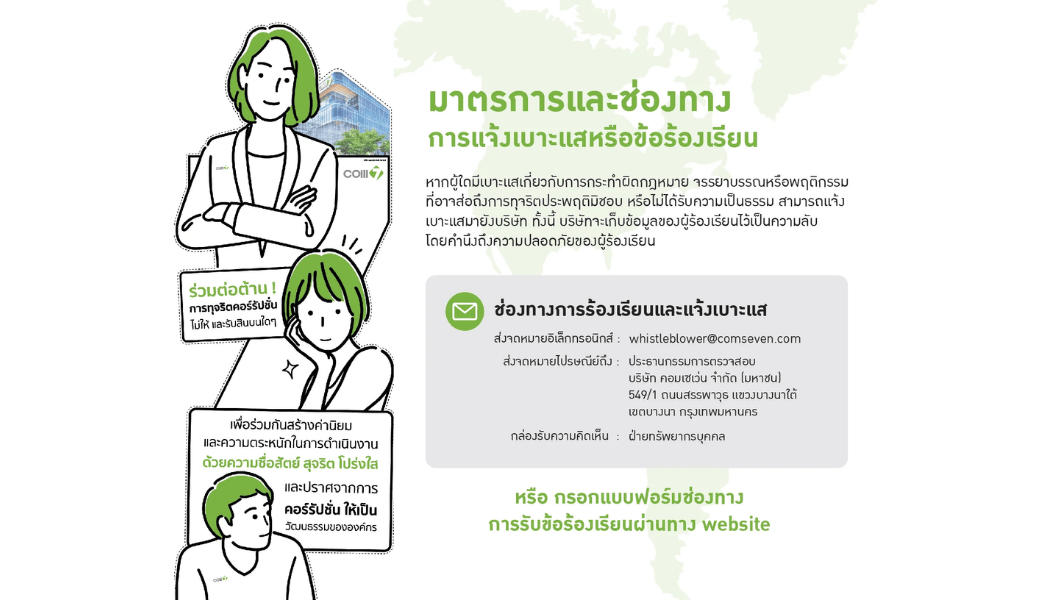
3. Whistleblower System The company recognizes the role of stakeholders from all sectors in corporate governance. Anyone who observes anything contrary to the Business Code of Conduct, fraud and corruption, or any other case, can report, inform, or submit a complaint directly to the Chairman of the Corporate Governance Committee, or the Head of Internal Audit, or the company's executives, or the Company Secretary, or through the complaint channels provided by the company, including any other channels trusted by stakeholders. The measures and channels for reporting tips or complaints are as follows: Measures and channels for reporting tips or complaints The company provides secure and accessible channels for employees and other individuals to seek advice regarding compliance with the anti-corruption policy and to report misconduct or complaints with confidence that whistleblowers will receive appropriate protection. The company also designates personnel to investigate and follow up on all reported matters as follows:
1.1 Consult with the "Human Resources Manager" or the "Internal Audit Manager" by • Telephone : 02-017-7777 ext. 7202 or 7741 • Send an email to : whistleblower@comseven.com • Send a letter by post to the address Comseven Public Company Limited, Head Office 549/1 Sanphawut Road, Bang Na Tai Subdistrict, Bang Na District, Bangkok 10260 1.2 The advice seeker may choose to remain anonymous. However, identifying the advice seeker will enable
• Send an email to : whistleblower@comseven.com • Send a postal letter to : Chairman of the Audit Committee Comseven Public Company Limited 549/1 Sanphawut Road, Bang Na Tai Subdistrict, Bang Na District, • Suggestion box : Human Resources Department
Actions upon receiving a complaint
Protection and Confidentiality Measures
| https://www.comseven.com/ir_index.php?corporate |

Code of Conduct
Introduction
The company is committed to doing what is right, conducting business in accordance with legal and regulatory operational guidelines, and encouraging its directors, executives, and employees to adhere to good practices and conduct themselves in a manner appropriate for professional business operations. This includes possessing integrity, being responsible towards the economy and society as a whole, and promoting a good corporate governance system based on honesty, fairness, and transparency. The company upholds justice and morality, prioritizes customers, is socially responsible, remains politically neutral, considers all stakeholder groups, avoids involvement in human rights violations, combats corruption, does not accept undue benefits, does not engage in soliciting or paying bribes, avoids conflicts of interest, and refrains from any actions that infringe upon the intellectual property or copyrights of others. These are fundamental principles based on "Business Ethics and Work Practices" that will promote the performance of directors and executives to achieve the company's objectives, vision, and goals, and will also enhance organizational efficiency. (The full policy and guidelines can be studied at http://www.comseven.com under the Investor Relations section). In 2025, there were no legal disputes between the company or its subsidiaries and customers.
The company has established the Company's Code of Business Conduct and the Code of Conduct for Directors, Executives, and Employees to be adhered to as guidelines, as follows:
Business ethics refers to the practices expected of the company.
Code of Conduct for Directors refers to the practices expected of directors.
Code of Conduct for Executives refers to the practices expected of executives.
Employee Code of Conduct refers to the practices expected of employees.
Code of Conduct for Investor Relations Officers refers to the practices expected of Investor Relations Officers.
Code of Conduct towards Stakeholders refers to the practices expected towards shareholders, employees, customers, business partners, creditors, competitors, communities and society, and the environment.
The company has established processes that promote and support the development of an organizational culture where employees have practices and feel a shared purpose with the organization, working together to create sustainable value for the organization, as follows:
Requires directors, executives, and employees to strictly adhere to the ethics of each group, including monitoring their performance.
Organizing training on business ethics principles and employee code of conduct, by integrating the training content as part of the orientation program for new employees, to ensure that employees at all levels are aware, understand, and can apply them in accordance with good corporate governance principles, business ethics, and expected work practices.
Promoting awareness through the company's business ethics principles for directors, executives, and employees, published on the company's website. (htttp:// www.comseven.com ) and through through the company's IT EASY Application annually, requesting the cooperation of directors, executives, and employees to complete the Code of Conduct questionnaire at 100%.
Furthermore, the company has developed and implemented a Supplier Code of Conduct and Guideline for its business partners to use as a framework for conducting business together responsibly within the supply chain.
Has a Business Code of Conduct
Yes
Code of Conduct Description
Com7 Public Company Limited (the Company), through its Board of Directors, is committed to ensuring that the organization conducts its business under the principles of good corporate governance and has standard management policies. The Company is dedicated to creating maximum benefits for shareholders and considering all stakeholders, by operating business in compliance with the law, disclosing information transparently and verifiably, setting goals for success with prudence, considering potential, and generating appropriate returns for shareholders, as well as considering the balance between business, society, and the environment, which will lead to becoming a sustainable organization.
The Company has established a "Business Ethics and Code of Conduct" manual to serve as a good practice guideline for the Company's directors, executives, and employees, by conducting business according to good governance principles and responsibility towards both internal and external stakeholders. In the past, the Company has focused on building knowledge and understanding of good corporate governance principles and fostering awareness in applying good corporate governance principles in daily work, thereby creating an organizational culture. Furthermore, the Company has mandated continuous review and monitoring of performance in accordance with the Business Ethics and Code of Conduct manual.
Code of Conduct Link
https://www.comseven.com/ir_index.php?corporate
Code of Conduct Practices
| Guideline | Other — Please Specify | Detail | Document Link |
|---|---|---|---|
| Prevention of Misuse of Inside Information | The company has established procedures for related party transactions with individuals who may have conflicts of interest, stipulating that such transactions must be reviewed by the Audit Committee or the Board of Directors, in accordance with specified criteria. It also requires the disclosure of transactions and the value of potential conflict-of-interest transactions from the past year. The company monitors executives and employees to ensure 100% completion of annual conflict of interest disclosure reports, clearly explaining the necessity and reasonableness of the transactions that have occurred. Furthermore, the company has communicated to executives and employees regarding the reporting of conflicts of interest and requires directors and executives involved in such transactions to disclose information and/or the nature of their personal relationships, spouses, and close relatives, in accordance with the Notification of the Securities and Exchange Commission regarding the acquisition or disposal of securities by directors and employees B.E. 2547 (2004). In the event that the company enters into any contract or conducts related party transactions with subsidiaries, affiliated companies, and/or third parties, the company will consider the necessity and appropriateness of entering into such contracts, primarily taking into account the company's best interests. | https://www.comseven.com/ir_index.php?corporate | |
| Anti-corruption | The Company is committed to conducting business responsibly, upholding ethics and morality, managing operations with transparency, in accordance with good corporate governance principles and the Company's business philosophy. Therefore, the Company has established a policy on complaints, whistleblowing of misconduct and corruption, investigations, and data protection, to serve as a guideline for practice. Definition: Corruption refers to "the act or omission of an act in an official capacity, or the misuse of official power, in violation of laws, regulations, or company policies, as well as against moral and ethical principles, to seek undue benefits in various forms, such as receiving, offering, or giving assets, goods, embezzlement, political assistance, and any other benefits to government officials, private companies, any other individuals, and related parties doing business with the Company and its subsidiaries, etc." Related parties refer to spouses, children, parents, siblings/close relatives of directors, executives, and employees at all levels of the Company and its subsidiaries. | https://www.comseven.com/ir_index.php?corporate | |
| Whistleblowing and Protection of Whistleblowers | Whistleblowing and Complaints 1) Send by sealed mail
2) Electronic mail whistleblower@comseven.com 3) Human Resources Department Feedback Box Scope of Complaints and Whistleblowing
In case of doubt All employees may seek advice or clarification on any doubts regarding this policy or actions that may be considered fraud or corruption. They should consult their direct supervisor, the Internal Audit Department, or the Human Resources Department. If unsure whether an action constitutes fraud or if they wish to discuss before filing a complaint, they may send an email to whistleblower@comseven.com | https://www.comseven.com/ir_index.php?corporate | |
| Preventing the Misuse of Inside Information | Internal Information Management and Protection
| https://www.comseven.com/ir_index.php?corporate | |
| Prevention of money laundering | Comply with laws related to the prevention and suppression of money laundering, the prevention and suppression of financial support for terrorism, and the proliferation of weapons of mass destruction. Do not accept, transfer, or convert any assets related to criminal offenses, and do not support transactions that may constitute money laundering, in order to prevent any individual from using the company as a channel or tool to conceal the origin of illegally obtained assets. | https://www.comseven.com/ir_index.php?corporate | |
| Giving or receiving gifts, entertainment, or business entertainment | Gift expenses, hospitality expenses, and other expenses refer to any items with monetary value, such as cash equivalents, items exchangeable for goods or services (e.g., complimentary coupons, discount coupons), food and beverage entertainment, expenses for watching performances/sports, as well as travel expenses (e.g., airfare, transportation costs, accommodation costs), etc. | https://www.comseven.com/ir_index.php?corporate | |
| Compliance with laws, rules and regulations | Ensuring adherence to good corporate governance principles and business ethics. The Company stipulates that it is the duty and responsibility of all directors, executives, and employees to understand and strictly comply with the policies set forth in this Business Ethics and Code of Conduct Handbook. Compliance is not voluntary, and ignorance of the established guidelines cannot be claimed. Executives at all levels within the organization must oversee and be responsible, and consider it important to ensure that employees under their supervision are aware of, understand, and seriously adhere to the Business Ethics and Code of Conduct Handbook. The Board of Directors and the Audit Committee mandate an annual review of the "Ethics and Code of Conduct Handbook." | https://www.comseven.com/ir_index.php?corporate | |
| Use and maintenance of data and assets | Responsibility for Company Assets The company encourages executives and employees to use the company's assets and resources efficiently, economically, and to their maximum benefit. They must collectively ensure that company assets do not depreciate or are improperly lost, and must not be used for personal gain or for the benefit of others unrelated to the company's business. Furthermore, the company is committed to protecting, safeguarding, and preserving intellectual property owned by the company or its group companies, such as copyrights, trademarks, patents, petty patents, know-how, and trade secrets, from infringement or unauthorized use. The company also respects the intellectual property rights of others and will not infringe upon or use them without authorization. The following guidelines are to be observed: 1) Documentation
2) Use of Computers and Information Technology Systems
3) Use and Care of Intellectual Property
| https://www.comseven.com/ir_index.php?corporate | |
| Anti-competitive | Responsibility towards Business Competitors The company is committed to conducting business fairly, adhering to ethical principles and good competition rules, without seeking confidential information from business competitors through dishonest or inappropriate means, without damaging the reputation of business competitors through malicious accusations, without entering into any agreements that restrict trade competition, and cooperates to enhance business potential for sustainable growth. | https://www.comseven.com/ir_index.php?corporate | |
| Cyber security | Use of Computers and Information Technology Systems
| https://www.comseven.com/ir_index.php?corporate | |
| Environmental management | Environmental Responsibility The company strictly adheres to various environmental laws and regulations. It encourages executives and employees to pay attention to activities that promote awareness of safety, occupational health, and the environment by implementing measures for energy conservation and the efficient and cost-effective use of resources. | https://www.comseven.com/ir_index.php?corporate | |
| Occupational health and safety | The company strictly adheres to various laws and regulations related to the environment. It encourages executives and employees to pay attention to activities that promote awareness of safety, occupational health, and environmental responsibility, by implementing measures for energy conservation and efficient and cost-effective resource utilization. | ||
| Other guidelines related to business code of conduct | Conflict of Interest | The Company has established procedures for conducting transactions with persons who may have a conflict of interest, stipulating that such transactions must be reviewed by the Audit Committee or the Board of Directors, in accordance with specified criteria. Furthermore, the transactions and their values that may have involved conflicts of interest in the past year must be disclosed. The Company monitors executives and employees to ensure that annual conflict of interest disclosure reports are completed one hundred percent, with clear explanations of the necessity and reasonableness of the transactions that have occurred. The Company has also communicated to executives and employees regarding the reporting of conflicts of interest and requires directors and executives involved in such transactions to disclose information and/or the nature of their personal relationships, including those of their spouses and close relatives, in accordance with the Notification of the Securities and Exchange Commission regarding the acquisition or disposal of securities by directors and employees B.E. 2547 (2004). In the event that the Company enters into any contract or conducts inter-company transactions with subsidiaries, affiliated companies, and/or third parties, the Company will consider the necessity and appropriateness of entering into such contracts, primarily taking into account the Company's best interests. | https://www.comseven.com/ir_index.php?corporate |
| Other guidelines related to business code of conduct | Internal Control | The Audit Committee is directly responsible for overseeing a sound internal control system, focusing on establishing an internal control system that aligns with the international internal control framework (The Committee of Sponsoring Organizations of the Treadway Commission (COSO)), covering key operational processes and activities. The internal audit function is responsible for auditing operations based on risk and providing consultation on establishing a sound internal control system. Furthermore, the Audit Committee is responsible for considering audit plans, supervising, monitoring, and providing recommendations for operations, as well as considering the independence of the internal audit department. This includes considering and approving the appointment, removal, transfer, and performance evaluation of the Head of Internal Audit. |
Promoting Compliance with the Code of Conduct
Promotes Compliance by Directors, Executives and Employees
Yes
Description
Code of Conduct for Directors
The company expects directors, sub-committee members, and subsidiary directors to perform their duties within the framework of laws, announcements, regulatory requirements, company regulations, ethics, and corporate governance principles. They shall perform their duties with honesty, integrity, care, and prudence for the utmost benefit of the company's continuous and sustainable business operations and its stakeholders, as follows:
1) Comply with all relevant regulations, rules, and laws pertaining to the company's business operations, as follows:
Directors, executives, and employees must comply with the laws, regulations, rules, and requirements of the Stock Exchange of Thailand and the Securities and Exchange Commission.
Directors, executives, and employees must not assist, support, or allow themselves to be used as tools to evade compliance with laws or regulations.
2) Perform duties with impartiality. If, during any meeting, a matter to be considered involves a conflict of interest for a director, that director must leave the meeting room and refrain from any involvement in the deliberation and decision-making process for that matter.
3) Avoid conflicts of interest for efficient and transparent management, as follows:
Do not use information obtained from performing duties to seek undue benefits for oneself or others.
Do not misuse organizational secrets and do not disclose confidential organizational information, even after resignation or termination of duties.
Do not seek personal gain from being a director.
Do not accept gifts or any other benefits that conflict with the organization's interests.
4) Maintain the confidentiality of organizational information, preventing its leakage to unauthorized persons, which could cause damage to the organization or its stakeholders, except when required by law.
5) The acquisition or disposal of listed securities by directors, spouses, and minor children must comply with the Notification of the Stock Exchange of Thailand Board regarding practices concerning the acquisition or disposal of securities by directors and employees B.E. 2547 (2004).
Code of Conduct for Executives and Employees
The company has established Corporate Governance Principles for Senior Executives (Executives Ethical Standard) and Best Practices for Employees, with severe penalties for violations and/or intentional non-compliance, as follows:
1) Corporate Governance Principles for Senior Executives
Maintain confidentiality and not disclose the company's confidential information to external parties without proper authority.
Refrain from or avoid expressing opinions to external parties or the media on matters related to the company without proper authority and duty.
Do not seek undue benefits, whether directly or indirectly, and do not engage in, accept, or support any form of corruption.
Do not engage in or participate in any actions or conceal any actions that create a conflict of interest, or that may prevent fair performance of duties, or participate in concealing any illegal acts.
Refrain from any actions that involve soliciting or accepting items, gifts, presents, or hospitality with a value exceeding 3,000 Baht (three thousand Baht) per instance. If refusal is not possible, disclose and submit the item to the Human Resources Department or the assigned unit.
Disclose personal relationships of oneself/spouse and close relatives using the personal information disclosure form and submit it to the Company Secretary's Office.
Do not use and/or provide any information or guidance regarding operational details that would result in one or more bidders gaining an unfair advantage or disadvantage in the bidding process.
2) Best Practices for Employees
Perform duties with honesty, integrity, fairness, responsibility, and prudence.
Perform duties diligently and continuously seek ways to develop and improve work.
Foster teamwork by cooperating and supporting each other for the benefit of work.
Prohibited from participating in or concealing any actions that may create a conflict of interest with the company, or that may prevent fair performance of duties, or from participating in concealing any illegal acts.
Supervisors should conduct themselves in a manner that earns the respect of their subordinates by setting a good example.
Employees should treat supervisors with respect and colleagues with kindness.
Prohibited from using company information obtained from performing duties to seek undue benefits for oneself or others.
Must maintain the confidentiality of the company by carefully ensuring that confidential documents or information do not leak or fall into the hands of unauthorized persons, which could cause damage to the company.
Refrain from any actions that involve soliciting or accepting gifts or other benefits from individuals who have duties or business dealings with the company, except on customary occasions or festivals where such practices are generally accepted.
Do not engage in any actions that cause damage to the company's image and reputation.
Inform relevant departments and management if any improper or illegal actions are found within the company.
Process Document Link
https://www.comseven.com/ir_index.php?governance_policy
Anti-Corruption Networks & Projects
Joined or Declared Intent to Join Anti-Corruption Networks
Yes
Networks & Projects Joined
| Network / Project | CAC Certified |
|---|---|
| Thai Private Sector Collective Action Against Corruption: CAC | Y |
| United Nations Global Compact (UNGC) | |
| Participation of anti-Corruption networks and initiatives |
Material Changes & Developments in CG
Reviewed the CG Policy or Board Charter in the Past Year
Yes
Material Changes or Developments in the Past Year
No
Policy Review — Description
In 2025, the Board of Directors resolved to approve the review and revision of the Good Corporate Governance Policy, the Corporate Sustainability Development Policy, and the Business Ethics and Code of Conduct, to ensure their suitability and alignment with the company's circumstances. This was approved by the Board of Directors Meeting No. 11/2025 on December 16, 2025. This demonstrates that the company has continuously updated its policies, guidelines, and governance system to enhance governance efficiency and elevate the company's corporate governance standards, in accordance with the Principles of Good Corporate Governance for Listed Companies 2017 (CG Code), at least once a year.
CG Code — Introduction
The company prioritizes good corporate governance as a crucial mechanism for sustainable value creation and for enhancing confidence among shareholders, investors, and all stakeholders. The company has adopted the Corporate Governance Code for Listed Companies (CG Code), as prescribed by the Securities and Exchange Commission, as a framework for its corporate governance, in conjunction with compliance with relevant laws, regulations, and requirements.
The Board of Directors and management play a crucial role in formulating policies, overseeing, and monitoring operations in accordance with the CG Code principles, covering key issues such as establishing an appropriate board structure and composition, defining the roles, duties, and responsibilities of the Board and its sub-committees, risk management and internal control, transparent information disclosure, as well as considering the rights and equality of shareholders.
The company continuously reviews and develops its corporate governance practices to suit the nature of its business, organizational size, and changing business environment, thereby supporting efficient, transparent, and sustainable business operations.
Implements the CG Code for Listed Companies
No
CG Code — Description
The company has adopted the Corporate Governance Code for Listed Companies (CG Code) prescribed by the Securities and Exchange Commission as a framework for corporate governance and largely implements it. However, in some practices, the company may not have fully complied, as it considers the suitability with its business characteristics, organizational size, shareholding structure, and business environment. The Board of Directors believes that such operations remain consistent with good corporate governance principles and do not significantly impact the company's corporate governance.
Examples of practices currently under consideration by the company include: Setting the term of office for independent directors not exceeding 9 consecutive years. Currently, the company prioritizes considering independence based on qualifications, performance of duties, knowledge, and abilities, as well as the absence of business relationships or interests that could significantly influence the independent directors' discretion. The Board of Directors believes that the independent directors can still perform their duties independently and effectively. However, the company will review these practices to ensure they are appropriate for the company's context and future best practices.
The company will continuously review and improve its corporate governance practices to comply with relevant regulations and changes in the business environment.
Other CG Performance & Outcomes
The company prioritizes good corporate governance as a crucial mechanism to support transparent, efficient, and sustainable business operations. As a result of its good corporate governance practices, the company is able to conduct business efficiently under appropriate risk management and internal control systems. It ensures accurate, complete, and timely disclosure of information, as well as strict compliance with relevant laws and regulations. Furthermore, the company continues to maintain the trust of shareholders, investors, and all stakeholders through a clear governance structure, appropriate definition of roles and responsibilities for the Board of Directors and management, and the promotion of an organizational culture of ethics and transparency. The outcomes of its adherence to good corporate governance principles are also reflected in external evaluations and recognitions in 2025, such as an 'AA' rating in SET ESG Ratings, selection as an ASEAN Asset Class PLC, awards from SET Awards, a full score in the AGM Checklist assessment, and an 'Excellent' (5-star) rating in the Corporate Governance Report (CGR). These achievements underscore the effectiveness of its corporate governance, risk management, and information disclosure. The company continuously reviews and develops its corporate governance practices to support sustainable growth.