

Risk Management · 2025
In this section3 topics
Risk Management Policy & Plan
Policy & Plan Description
The company recognizes that risk management is an integral part of good corporate governance, which is a crucial foundation enabling the company to achieve its objectives. Identifying and managing risks supports better decision-making and helps in recognizing opportunities, as well as mitigating negative impacts from potential significant events.
The Board of Directors has established guidelines in the Risk Management Policy for operational efficiency and to serve as a management tool that enhances the chances of achieving the company's objectives (see the full policy and guidelines at http://www.comseven.com under the Investor Relations section). The key points of this policy are as follows:
Promote a risk management culture to foster shared understanding, awareness, and responsibility regarding risks. All executives and employees of the company are risk owners, responsible for identifying and assessing risks within their respective departments, as well as establishing appropriate measures to manage these risks.
Establish quality, internationally appropriate, and sufficient risk management processes, guidelines, and measures, including identifying, analyzing, assessing, prioritizing, managing, controlling, monitoring, reporting, evaluating, and continuously communicating information about risks throughout the company.
Conduct business within acceptable risk levels, with defined risk limits to cap potential damages at an acceptable level. Risk management is integrated into the annual business planning, operations, and decision-making processes.
2.1.1 Operational Framework
The company has an appropriate risk and crisis management system, referenced against international standards from The Committee of Sponsoring Organizations of the Treadway Commission (COSO), the international standard ISO 31000, as well as the principles of good corporate governance for listed companies in 2017 (CG Code 2017), and anti-corruption guidelines. This enhances the company's confidence in continuously achieving its objectives and goals. The company mandates risk assessment, which includes identifying risks, analyzing risks, and measuring risk levels, all to respond to or manage risks to an acceptable level. Furthermore, the company continuously monitors and reports risk management results at all levels, ensuring that the company has sufficient and appropriate risk assessment, management, and measures covering operations throughout the company, thereby instilling confidence in the company's operations among its stakeholders.
2.1.2 Risk Management Structure
The company has established a risk management process and appointed a Risk Management Committee, comprising independent directors and executive representatives from various departments. This committee is responsible for setting policies and assessing risks by identifying factors that may prevent the company from achieving its stated objectives, as well as evaluating impacts and opportunities to determine risk management measures to an acceptable level for the company. The Risk Management Committee reports the results of its risk assessment to the Audit Committee and the Board of Directors for review at least once a year.
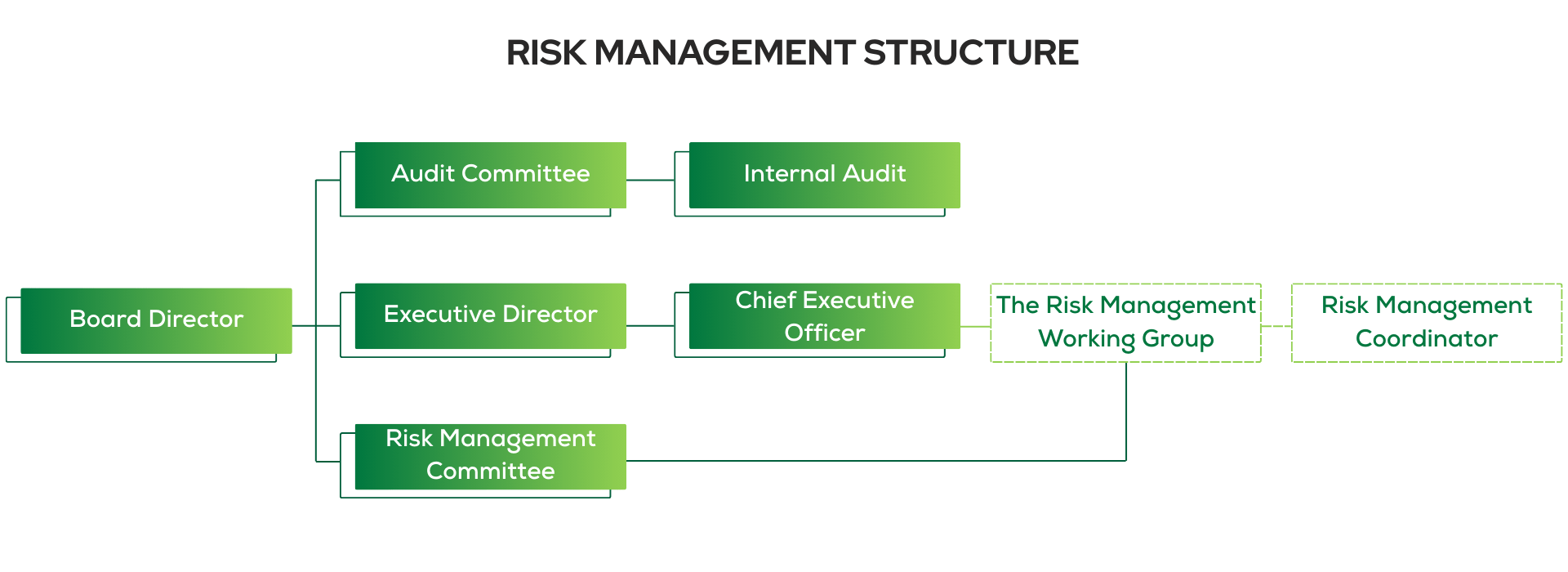
Board of Directors The Board of Directors is responsible to shareholders for the company's business operations, overseeing the business to align with objectives, laws, company articles of association, resolutions of shareholder meetings, and guidelines that will generate maximum benefit for shareholders, while considering the interests of all stakeholders. They perform their duties with honesty, integrity, and diligence to protect the interests of shareholders and stakeholders, both in the short and long term.
Executive Committee Responsible for operating and managing the company's business in accordance with the objectives, articles of association, policies, regulations, requirements, orders, and resolutions of the Board of Directors' meetings and/or resolutions of the company's shareholder meetings. It reviews proposals from management and presents policies, goals, strategies for the company's business operations, investments, business expansion, and budgets to the Board of Directors' meeting for consideration and approval.
Audit Committee Responsible for reviewing that the company's financial reporting is accurate and sufficient, and for reviewing that the company has appropriate and effective internal control and internal audit systems that are independent and impartial. The company's internal control system must be reviewed annually.
Risk Management Committee Responsible for proposing the overall risk management policy and framework (Integrated Risk Management) to the Board of Directors for their consideration and establishment as a company-wide policy. It monitors the progress of the company's risk management plan implementation, communicates significant risks to the Audit Committee, and reports risks and risk management to the Board of Directors.
Risk Management Working Group Responsible for supporting the work of the Risk Management Committee and for assessing organizational risks, including evaluating the adequacy of the risk management plan, monitoring the progress of risk management plan implementation, as well as promoting, disseminating knowledge, and providing advice and consultation to various departments. It is also responsible for reporting the organization's risk management to the Risk Management Committee, with Mr. Kritawat Worawanich serving as the Head of the Risk Management Working Group.
2.1.3 Risk Management Guidelines
The company regularly conducts continuous enterprise-level risk assessments, covering all company activities. All risks affecting the achievement of the company's objectives must be addressed as follows:
The Board of Directors, executives, all employees, and every department are risk owners, responsible for effectively assessing, monitoring, and supporting the risk management process.
Every department must have a systematic and continuous risk management, evaluation, and monitoring process. This process must be regularly updated to suit business changes, at least twice a year.
Assess risks by considering risks comprehensively across the organization, taking into account opportunities and factors of risk occurrence both internal and external to the organization, and prioritizing risks.
Manage risks in accordance with established risk management criteria, taking into account associated costs and the impact of such risk management.
Monitor and ensure that the company's risks are appropriately managed. All high and very high-level risks that may affect the company's business plans and strategies must be reported to the Risk Management Committee and the Board of Directors.
If there are risks that cannot yet be managed to an acceptable level, or if risk management activities could not be implemented in the first half of the year, they should be promptly managed in the second half. This involves reviewing and improving risk management activities to be more cost-effective, appropriate, and practically feasible.
Create an organizational culture that fosters shared understanding and risk awareness by building a knowledge base, enabling employees at all levels to study and research information to develop and improve risk management processes into an effective strategic management mechanism.
Policy Document Link
https://www.comseven.com/ir_index.php?corporate
Risks to the Company's Business Operations
Introduction
The company analyzes the business environment, encompassing both internal and external factors, as well as trends in economics, society, politics, industrial technology, competitors, and other relevant aspects. This analysis aims to identify significant risk factors at various levels, which are then considered, analyzed, and summarized as enterprise-level risk factors pertinent to business operations and potentially having a significant impact on performance, as follows:
Risk Register
| Risk Name | Risk Characteristics | Consequences | Management Measures | Related Risk Factors |
|---|---|---|---|---|
| Risk of inventory obsolescence | The company's core business is the retail sale of IT products. The company is required to maintain sufficient inventory for distribution to each of its stores. However, IT products are subject to continuous technological development and change, necessitating a response to consumer demands. | Risks may arise from the company's inventory becoming obsolete, increased administrative costs, and the potential need for provisions for obsolete or impaired inventory, which could impact the company's revenue. | The company utilizes the ITEC Stock system, which assists in managing product sales and branch inventory. This system can analyze sales data and consumer demand for each branch, as well as check the remaining stock levels at each branch. This allows the company to track product movement and plan and determine the appropriate stock levels for each branch. Furthermore, the company employs marketing strategies and sales promotions to stimulate sales and clear existing inventory before it becomes unpopular. Additionally, the company receives special conditions from major distributors and manufacturers for certain product models, such as special discounts, returns of obsolete models in exchange for new ones, or compensation for price differences in case of price reductions (Price Protection). These measures can help mitigate the problem of inventory obsolescence to a certain extent. Furthermore, mobile applications have been developed to support various operations, ranging from real-time and continuous inventory management reporting to facilitating internal personnel. These applications support both Android and iOS operating systems. Additionally, policies have been established for setting allowances for obsolete inventory based on product type and age to reflect the true value of the goods. Measures have also been defined for managing risks in this regard, such as:
Based on the aforementioned marketing strategies, coupled with the knowledge, capabilities, and experience of the management, the company is therefore minimally affected by this risk. | 732 · Description: Changes in technologies · Info category: STRATEGIC_RISK · 743 · Description: Product obsolescence · Info category: OPERATIONAL_RISK |
| Risks of personal data privacy or human rights violations | The company is committed to developing the organization for sustainable growth, operating its business in accordance with the law, complying with relevant rules, regulations, and laws, disclosing information transparently, and maintaining good and appropriate oversight mechanisms. |
|
| 758 · Description: Violations of laws and regulations · Info category: COMPLIANCE_RISK · 753 · Description: Impact on human rights · Info category: OPERATIONAL_RISK |
| Cyber threat risk | Cyber risks are likely to be affected by disruptions to sensitive data, finances, or online business operations, including certain services critical to business operations. These risks may be related to incidents that could lead to data breaches, data theft, or data destruction. Cyber risks pose a security threat to the operations of businesses and organizations. | Disruption to sensitive data, finances, or online business operations. Impersonation scams to access protected information have also become easier, significantly impacting business operations. | The company employs a cybersecurity strategy by engaging with cybersecurity personnel, who will assess the security risks of computer systems, as well as networks, data storage, applications, and other connected devices. Subsequently, the cybersecurity personnel will establish a comprehensive cybersecurity framework and implement preventive measures within the organization. | 744 · Description: Information security and cyber-attack · Info category: OPERATIONAL_RISK |
| Risk from business competition | The company's core business involves importing and retailing IT products such as laptop computers, desktop computers, mobile phones, tablets, and related accessories. This is a highly competitive business, encompassing competition among manufacturers themselves in continuously developing and launching new products to best meet consumer demands and capture market share, as well as competition among distributors who are direct competitors of the company. Currently, approximately 80% of the company's total revenue from sales and services is derived from the sale of IT products and mobile phones. Should there be intense market competition or the entry of new, highly capable competitors into the business, it could significantly impact the company's overall performance. |
| The Company believes that new operators entering the retail business may encounter limitations in securing retail space, as existing tenants already occupy prime locations. Additionally, the Company maintains strong relationships and possesses significant expertise and proficiency in space management, as demonstrated by the fact that its leased spaces have never been terminated by landlords throughout its operational history. Furthermore, the IT retail business typically operates with low profit margins, and individual operators set similar selling prices for the same type of products. Competition in this sector therefore focuses on comprehensive distribution channels that effectively reach target customers, as well as building customer confidence in product quality, providing impressive service, and offering reliable after-sales support. As of December 31, 2025, the Company has branches covering 76 out of 77 provinces, operating under the names BaNANA, Studio 7, and Brand Shop. These include general IT product stores, Apple brand stores, and other brand shops. This extensive network ensures that the Company possesses comprehensive distribution channels that reach target customers at all levels, along with dependable after-sales services. Moreover, with the knowledge, capabilities, and experience of its executives, the Company is confident in its readiness and ability to be a competitive leader among other operators in the business. | 733 · Description: Business operations of partners in the supply chain · Info category: STRATEGIC_RISK |
| Risks from Branch Expansion | As the company's business is IT product retail, and the primary distribution channel for products is physical stores, the company has a policy to continuously expand its branches to increase opportunities and distribution channels, ensuring comprehensive coverage and maximum reach to target customers. Consequently, the company faces a risk if the performance of newly opened branches does not meet expectations or deviates from projections. | The performance of newly opened branches may not meet expectations or may deviate from projections. | The Company operates a business expansion unit, which possesses extensive experience and expertise. This unit is tasked with studying and analyzing the return on investment, profitability, branch locations, target customer demographics, area dimensions, and sales figures, benchmarked against branches of comparable size. Furthermore, close monitoring of branch operational performance is mandated. In instances where post-opening sales do not align with predetermined targets, the Company will undertake a thorough analysis of the underlying issues to implement appropriate corrective measures or, alternatively, consider the relocation or closure of underperforming branches. Additionally, the Company possesses a specialized department proficient in overseeing and managing the branch decoration process, which contributes to a modest budget for branch decoration. Furthermore, most assets are movable, ensuring that in the event of a branch relocation, the Company will not be required to invest in entirely new assets. The Company also engages in negotiations to reclaim deposits from shopping centers or landlords, and historically, it has successfully recovered these deposits, thereby minimizing potential losses in cases of branch relocation or closure. Coupled with the management's extensive experience and expertise in selecting optimal branch locations and managing operations, as evidenced by the Company's consistently increasing revenue and number of branches annually, the Company is confident that the expansion of new branches will broaden sales channels and opportunities to effectively reach target customer segments, ultimately delivering a valuable return on investment. | 1714 · Description: Competition risk · Info category: STRATEGIC_RISK |
| Risk of reliance on a limited number of suppliers | The company operates as a retail business, procuring products from both domestic and international sources. However, certain product items are dependent on a single supplier. The company has implemented advance planning for procurement and sourcing to ensure a continuous supply of products for sale. This also includes planning to manage risks associated with exchange rate fluctuations. Furthermore, a dedicated department is responsible for product research and selecting manufacturers certified with production standards, thereby ensuring the company maintains high-quality products and a continuous supply of substitute products for sale. | If the seller is unable to deliver goods as scheduled, increases prices, changes policies, or ceases operations, it may lead to raw material shortages, increased costs, or an inability for the company to conduct business as usual. |
| 735 · Description: Reliance on large partners / distributors or few partners / distributors · Info category: STRATEGIC_RISK |
| Risk of non-compliance with relevant regulations, rules, and laws | Compliance Risk refers to the risk arising from a company's inability to comply with relevant laws, regulations, rules, contracts, or various agreements pertaining to its operations in a timely or appropriate manner, which may lead to various adverse impacts. |
|
| 756 · Description: Change in laws and regulations · Info category: COMPLIANCE_RISK · 758 · Description: Violations of laws and regulations · Info category: COMPLIANCE_RISK · 759 · Description: Corporate Governance · Info category: COMPLIANCE_RISK |
Risks to Securities Holders' Investment
Risk Register
| Risk Name | Risk Characteristics | Consequences | Management Measures | Related Risk Factors |
|---|---|---|---|---|
| Risk from a major shareholder holding over 25% of shares | As of December 30, 2025, the company's major shareholder is Mr. Sura Kanittavakul, who holds 25.18 percent of the company's total issued shares. This proportion of shareholding grants the major shareholder group significant power in management and control over nearly all important resolutions. | The major shareholders possess the authority to manage and control almost all voting power in significant resolutions. | The company recognizes the importance of checks and balances and has therefore established a management structure that includes an Audit Committee. This committee comprises three independent external individuals selected and appointed to the Board of Directors, out of a total of seven directors. Their role is to review operations and provide checks and balances as representatives of minority shareholders. They also assist in scrutinizing important matters, such as the reasonableness of connected transactions, prior to their submission to the shareholders' meeting. Furthermore, measures and guidelines have been established for related party transactions involving directors, major shareholders, executives, controlling persons, and individuals who may have conflicts of interest, to ensure transparency and fairness to all shareholders equally. | 2970 · Description: Risk of the company having a majority shareholder holding > 25% of shares · Info category: HOLDER_RISK |
| Risk of Dependence on Management | Risk from reliance on a single key executive. As the company's key executive possesses extensive experience in the business, demonstrates vision in sales and marketing strategies, and in identifying potential branch locations, and maintains strong relationships with major suppliers, department stores, and shopping centers that own the premises, the company may face risks associated with its dependence on this key executive for management. Should there be a change in the key executive and an inability to recruit a suitably qualified individual, this could significantly impact the company's management and operations. | Risk of over-reliance on a single key executive, as the company's key executive may impact strategy formulation, among other factors. | The Company recognizes the risk factors arising from reliance on such executives. Therefore, it has a policy to support the Company's personnel in participating in the formulation of the Company's strategies and business plans and to promote teamwork to enhance work potential and efficiency. Additionally, personnel are continuously trained to gain further knowledge and understanding of their work, aiming to develop experienced and capable personnel to succeed the executives. Furthermore, the Company's key executives, namely Mr. Sura Kanittavakul, and the executives who are shareholders of the Company, have mostly been with the Company since its inception. The Company is therefore confident that the key executives will continue to work with the Company in the long term. | 769 · Other name: Risk of Over-Reliance on Executives · Description: Other · Info category: HOLDER_RISK |
| Risk of major shareholders' non-compliance with financial support agreements | According to the terms of the financial support agreement that the company has with the bank, there are stipulations regarding the maintenance of the shareholding proportion and the position of key executive held by Mr. Sura Kanittanont, who is a major shareholder of the company, throughout the duration of the said financial support agreement. However, the major shareholder has entered into an agreement with the company (Undertaking Agreement) certifying that he will maintain the shareholding proportion as stipulated by the bank and will remain a key executive of the company until the bank agrees to revoke such stipulations. The company is confident that the major shareholder will cooperate in complying with these stipulations to ensure the company continues to receive financial support from the bank. | Major shareholders failed to honor their commitment to maintain their shareholding proportion as stipulated by the bank. | The major shareholder(s) has entered into an agreement with the company (Undertaking Agreement), certifying that they will maintain the shareholding proportion as stipulated by the bank and will remain a key executive of the company until the bank agrees to waive such requirements. The company is confident that the major shareholder(s) will cooperate in complying with these requirements to ensure the company continues to receive financial support from the bank. | 769 · Other name: Risk of major shareholders' non-compliance with financial support agreements · Description: Other · Info category: HOLDER_RISK |